Deborah & William Hillyard
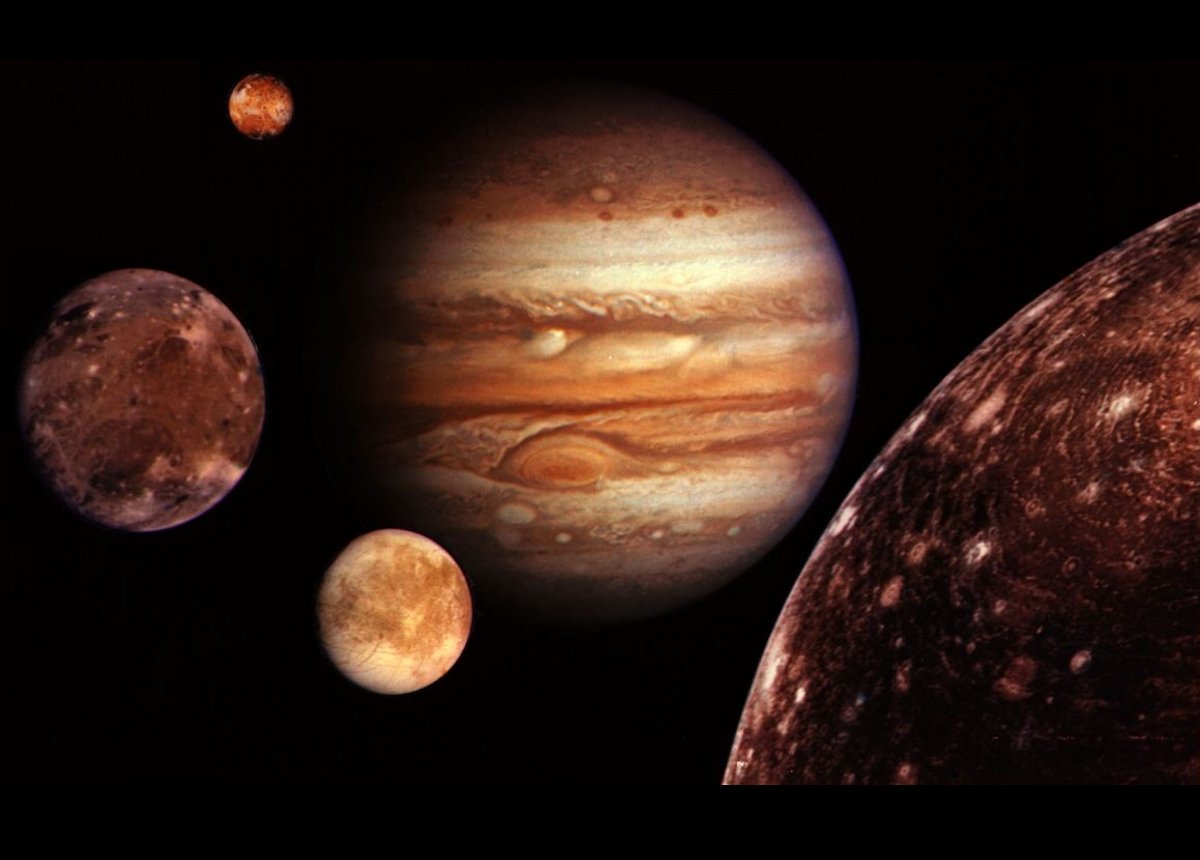
Jupiter and its four planet-sized Galilean moons, were photographed by the Voyager 1 probe, and assembled into this collage. They are not to scale. 
                                       Credit: NASA/JPL
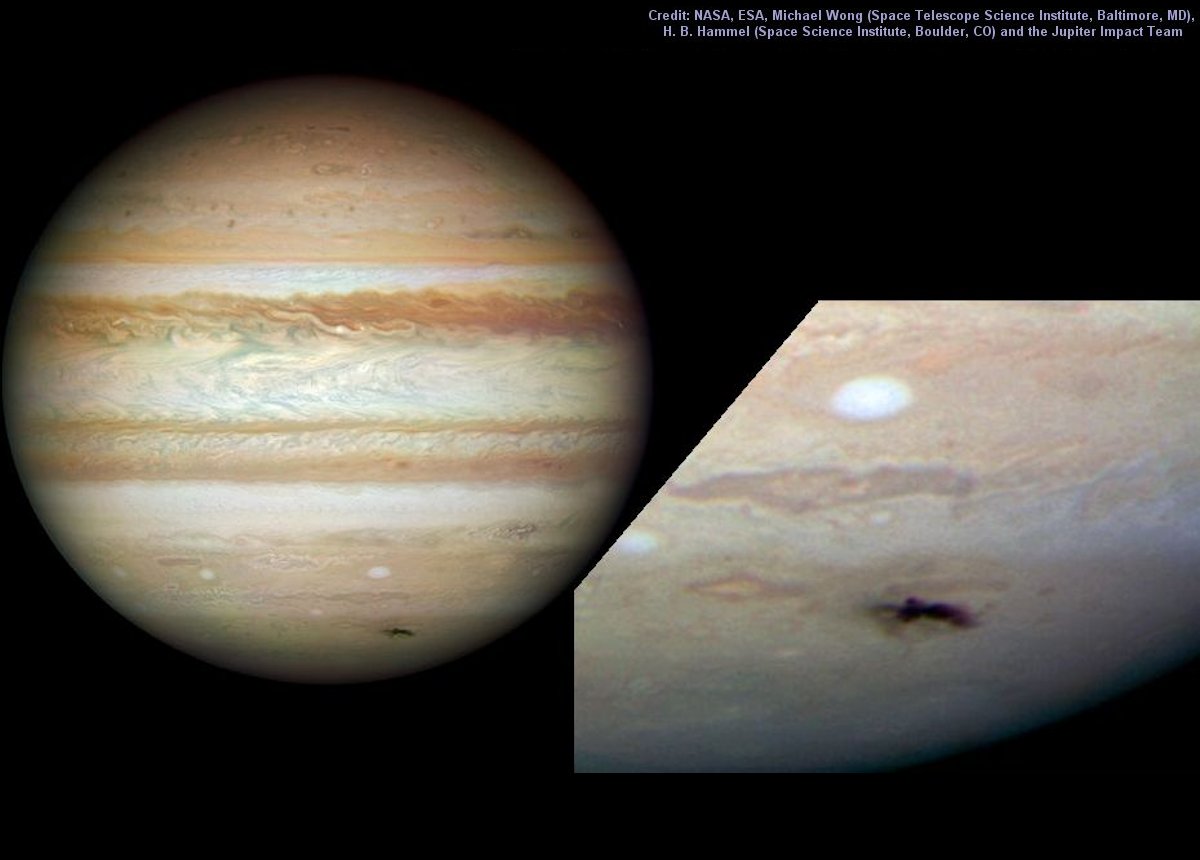
Hubble image taken on July 23 showing a blemish about 5,000 miles long left by the 2009 Jupiter impact. 
                                 See Image for Credit.
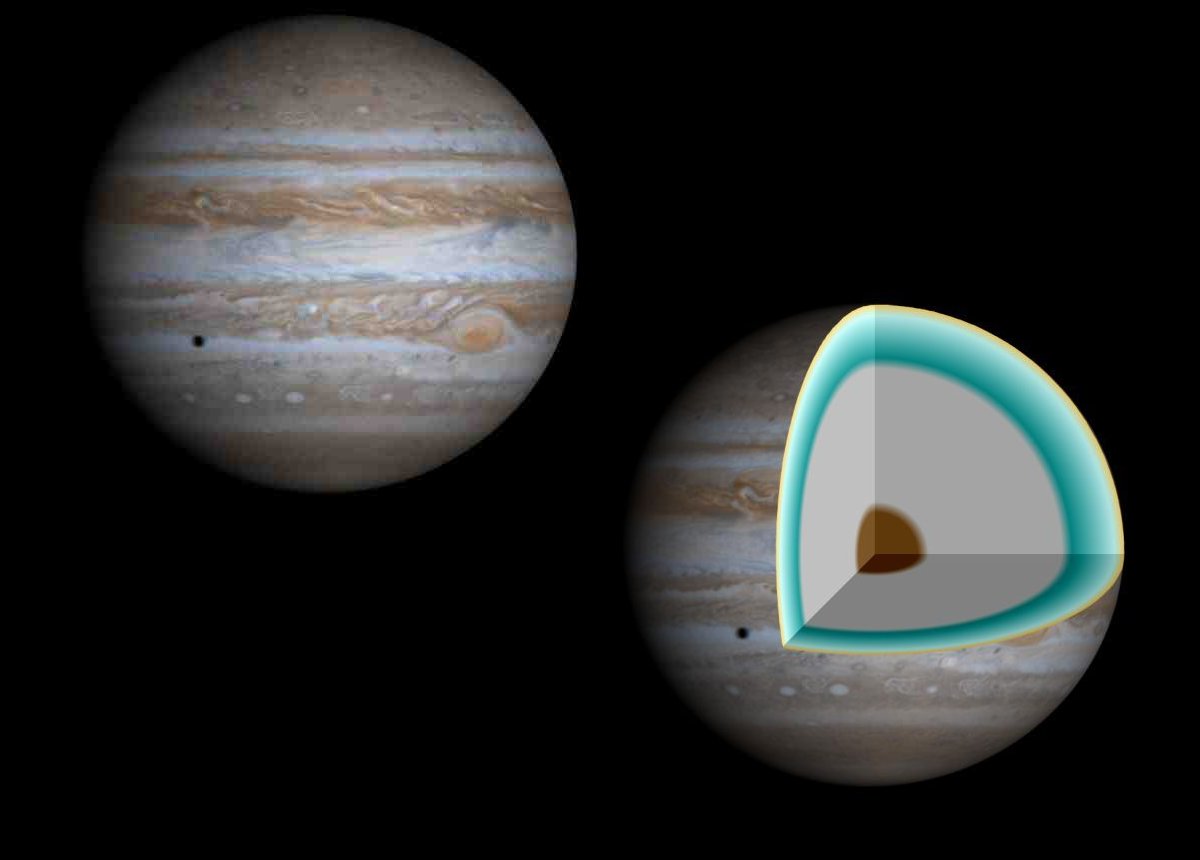
This cut-away illustrates a model of Jupiter's interior.  In the upper layers, the atmosphere transitions to a liquid state above a thick layer of metallic hydrogen.  In the center there may be a solid core of heavier elements.

                                                                              Credit: NASA/R.J. Hall

Images of Jupiter

Solar System -

Jupiter

A true-color view of Jupiter comprising four images taken by NASA's Cassini spacecraft. Jupiter's moon Europa is casting the shadow on the lower left of the planet.  Interestingly, the southern equatorial belt, the lower of the two main bands of cloud near the equator, has disappeared as of June 2010.  You can read about it at Big Mystery: Jupiter Loses a Stripe
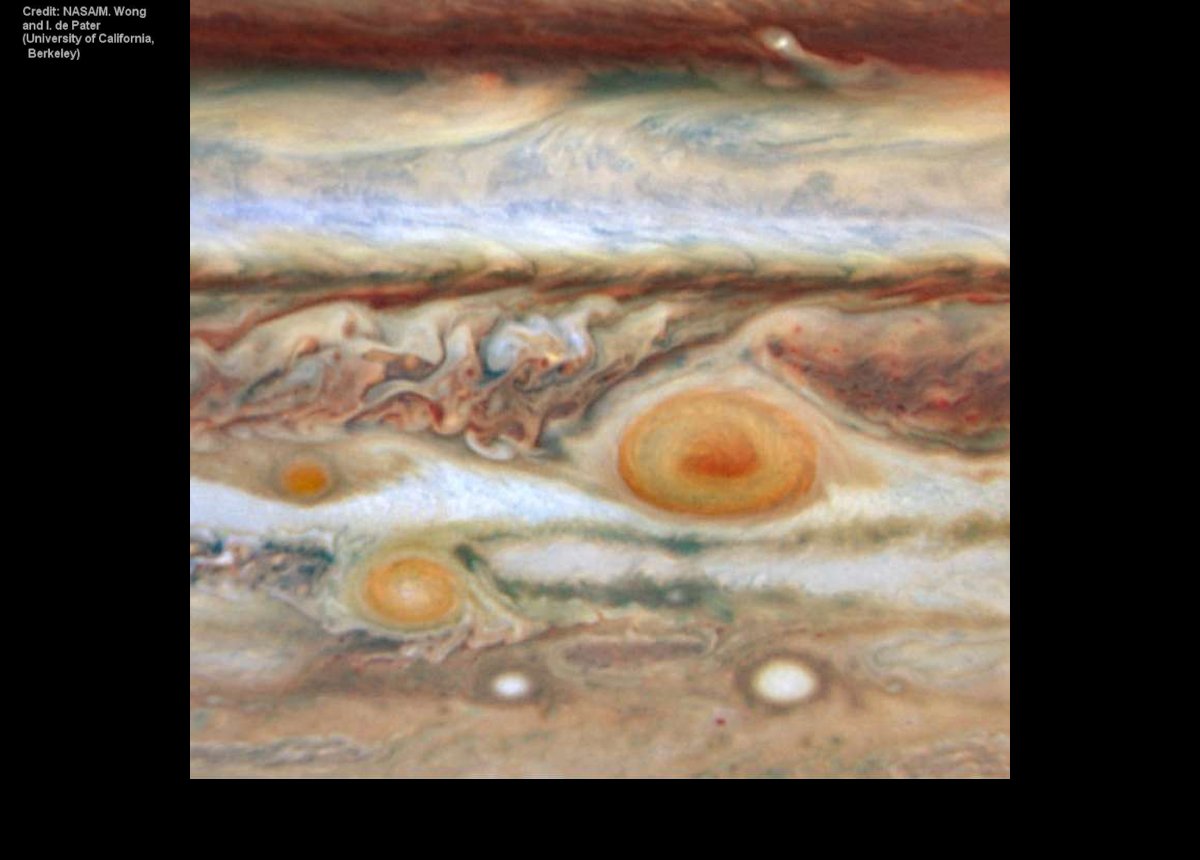
A third red spot has appeared alongside the Great Red Spot and Red Spot Jr.  This third red spot is a fraction of the size of the two other features.  Previously, this third spot was a white oval-shaped storm. The change to a red color indicates it is rising in the atmosphere to the level of the Great Red Spot. One possible explanation is that the red storm is so powerful it dredges material from deep beneath Jupiter's cloud tops and lifts it to higher altitudes where solar ultraviolet radiation — via some unknown chemical reaction — produces the familiar brick color.
Credit: M. Wong and I. de Pater (University of California, Berkeley)


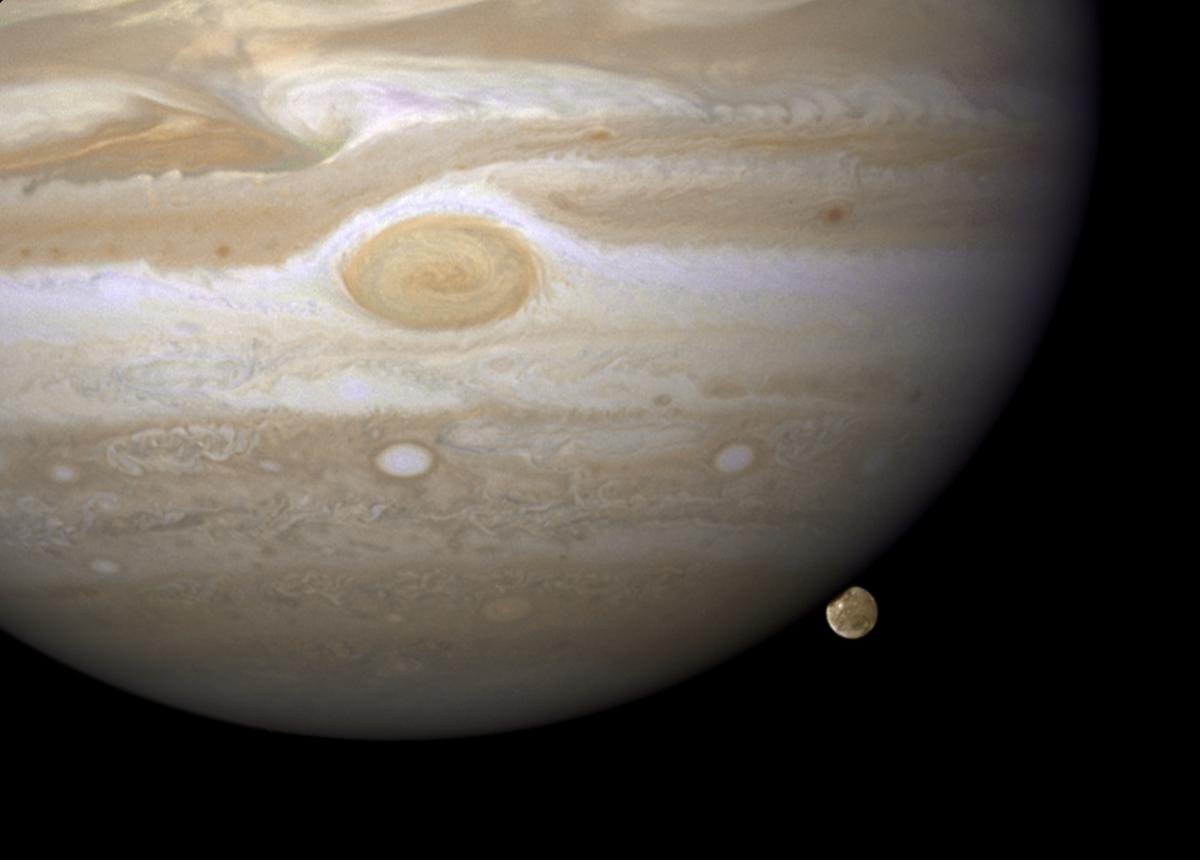
Hubble Space Telescope image of Jupiter's moon Ganymede just before it passes behind Jupiter's disk.  You can see Jupiter's Great Red Spot, which is a storm about twice the size of Earth.  The spot has been around for at least 300 years.
Menu: