Solar System -
Jupiter's Moons
Ganymede
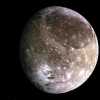
Ganymede is the largest moon in the Solar System. It orbits Jupiter once every 7 days, 3 hours and 43 minutes in a low eccentricity orbit of 1,070,400 km radius. It is 5,268 km (3,270 miles) in diameter, which is about 8% more than the planet Mercury, though it has less than half the mass. It is in a 1:2 orbital resonance with Europa, and a 1:4 resonance with Io.
The moon comprises roughly equal amounts of silicate rock and water ice, and was initially thought to have a rocky core. Galileo found that Ganymede has a magnetic field, so it must have an iron-iron sulfide, liquid core. The moon is fully differentiated, with three main layers:
• A sphere of metallic iron at the center (the core),
• a spherical shell of rock (the mantle) surrounding the core
• a spherical shell of mostly ice, mixed with some rock, surrounding the mantle. While rigid on the surface, this layer would soften further in.
The ice shell is up to 800 kilometers (497 miles) thick, and continues to the surface. Like Europa and Callisto, it may have a liquid ocean some 200 km below its surface, sandwiched between ice layers. Its surface is old, dating back to early in the creation of the Solar System. One half comprises very old, dark, and highly cratered dark regions, while the other half is a lighter and little younger with extensive grooving and ridging due to tectonic activity in the distant past. Like other icy moons, the edges of craters become softened as the surface flows over geological time. Palimpsests, in the astronomical rather than literary sense, are very old craters that have almost entirely disappeared due to viscous relaxation leaving only a vague outline. This gives us clues about the past structure of the moon.
Observations using the Hubble Space Telescope found evidence of thin oxygen atmosphere, though it is far too thin to support life as we know it. It probably results from radiation breaking water down into hydrogen and oxygen, with the hydrogen escaping much more quickly due to its lower atomic weight. Ganymede probably formed in the accretion disk that surrounded Jupiter in the early days of the Solar System. It appears to have formed fairly rapidly, in perhaps 10,000 years. Much faster than, for example, Callisto.
Click here to see some images of Ganymede:
The moon comprises roughly equal amounts of silicate rock and water ice, and was initially thought to have a rocky core. Galileo found that Ganymede has a magnetic field, so it must have an iron-iron sulfide, liquid core. The moon is fully differentiated, with three main layers:
• A sphere of metallic iron at the center (the core),
• a spherical shell of rock (the mantle) surrounding the core
• a spherical shell of mostly ice, mixed with some rock, surrounding the mantle. While rigid on the surface, this layer would soften further in.
The ice shell is up to 800 kilometers (497 miles) thick, and continues to the surface. Like Europa and Callisto, it may have a liquid ocean some 200 km below its surface, sandwiched between ice layers. Its surface is old, dating back to early in the creation of the Solar System. One half comprises very old, dark, and highly cratered dark regions, while the other half is a lighter and little younger with extensive grooving and ridging due to tectonic activity in the distant past. Like other icy moons, the edges of craters become softened as the surface flows over geological time. Palimpsests, in the astronomical rather than literary sense, are very old craters that have almost entirely disappeared due to viscous relaxation leaving only a vague outline. This gives us clues about the past structure of the moon.
Observations using the Hubble Space Telescope found evidence of thin oxygen atmosphere, though it is far too thin to support life as we know it. It probably results from radiation breaking water down into hydrogen and oxygen, with the hydrogen escaping much more quickly due to its lower atomic weight. Ganymede probably formed in the accretion disk that surrounded Jupiter in the early days of the Solar System. It appears to have formed fairly rapidly, in perhaps 10,000 years. Much faster than, for example, Callisto.
Click here to see some images of Ganymede:


Inner Moons • Io • Europa • Ganymede • Callisto • Himalia Group • Carme Group • Ananke Group • Pasiphae Group • Miscellaneous
Jupiter's moons are grouped as follows. Select to see details of the moon or the group of moons: