Solar System -
Jupiter's Moons
Io
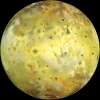
Io is the innermost of Jupiter's four Galilean moons, the others being Europa, Ganymede and Callisto. It has a diameter of 3,642 kilometers (2,263 miles), and orbits at a distance of 421,700 km (262,000 miles) from Jupiter. Interestingly, Io's orbit is in a 2:1 resonance with Europa (two orbits for every one of Europa) and a 4:1 resonance with Ganymede (four orbits for every one of Ganymede). It orbits once every ~42.5 hours, and rotates synchronously keeping the same hemisphere facing Jupiter.
Io is said to be the most geologically active object in our Solar System having more than 400 known active volcanoes producing huge sulfurous plumes that rise to over 500 km (310 miles) in Io's weak gravity. The lava flows produced are similarly large, many reaching more than 500 km (310 miles). There are large number of mountains, up to about 150, some of which exceed the height of mount Everest reaching 18 km (11 miles) high. This geological activity is largely the result of tidal heating caused by being pulled around by Jupiter and the resonances with the other Galilean moons. The constant renewing of the surface has also obliterated traces of craters left by meteor bombardment. There are large number of mountains, up to about 150, some of which exceed the height of mount Everest reaching 18 km (11 miles) high. The mountains appear to be formed by compression in Io's lithosphere.
Io has a molten iron core, making up about 20% of its mass. The core also contains unknown proportions of sulfur and nickel. This core is surrounded by a rocky layer, that may be partly molten, with a rocky surface covered in sulfur and sulfur dioxide frost.
Click here to see some images of Io:
Io is said to be the most geologically active object in our Solar System having more than 400 known active volcanoes producing huge sulfurous plumes that rise to over 500 km (310 miles) in Io's weak gravity. The lava flows produced are similarly large, many reaching more than 500 km (310 miles). There are large number of mountains, up to about 150, some of which exceed the height of mount Everest reaching 18 km (11 miles) high. This geological activity is largely the result of tidal heating caused by being pulled around by Jupiter and the resonances with the other Galilean moons. The constant renewing of the surface has also obliterated traces of craters left by meteor bombardment. There are large number of mountains, up to about 150, some of which exceed the height of mount Everest reaching 18 km (11 miles) high. The mountains appear to be formed by compression in Io's lithosphere.
Io has a molten iron core, making up about 20% of its mass. The core also contains unknown proportions of sulfur and nickel. This core is surrounded by a rocky layer, that may be partly molten, with a rocky surface covered in sulfur and sulfur dioxide frost.
Click here to see some images of Io:
Inner Moons • Io • Europa • Ganymede • Callisto • Himalia Group • Carme Group • Ananke Group • Pasiphae Group • Miscellaneous
Jupiter's moons are grouped as follows. Select to see details of the moon or the group of moons: