



Solar System -
Saturn
Saturn has sixty-two moons, though only 18 were known when Cassini first set off for Saturn in 1997. Most are very small, some just a few km across, and only thirteen that are larger than 50 km (about 30 miles) in diameter. Most of the moons fall into one of a number of groups of related satellites shown in the list above.
The ages of Saturn's moons vary greatly. Rhea and Tethys, for example, appear to be billions of years old while some appear relatively young; possibly the result of a larger body breaking up. Some of the outer moons appear to be captured asteroids. All the moons are icy, but the proportion of ice to rock varies.
Here is an alphabetical list of the fifty-three named moons:
The ages of Saturn's moons vary greatly. Rhea and Tethys, for example, appear to be billions of years old while some appear relatively young; possibly the result of a larger body breaking up. Some of the outer moons appear to be captured asteroids. All the moons are icy, but the proportion of ice to rock varies.
Here is an alphabetical list of the fifty-three named moons:
Saturn's Moons
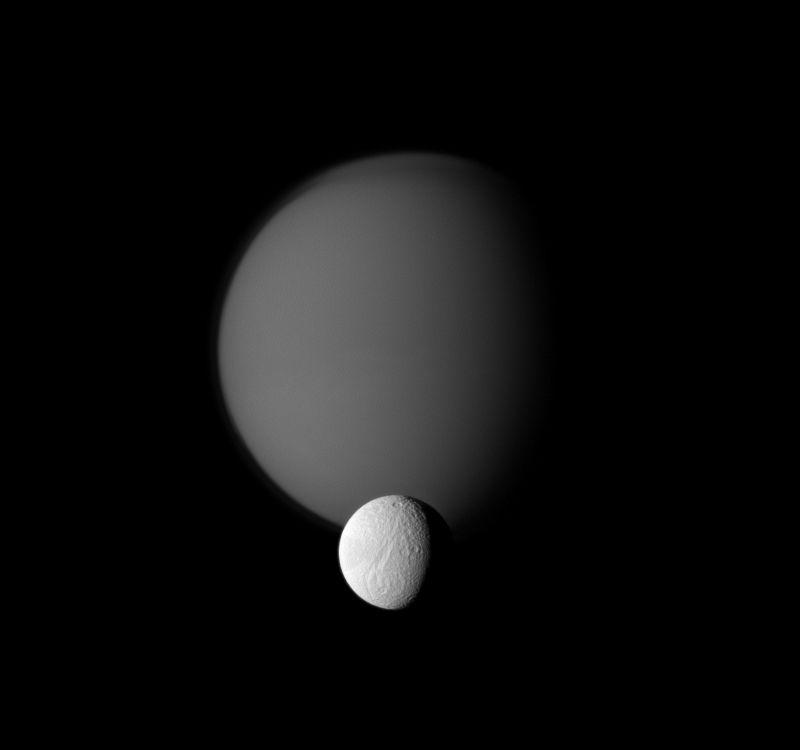
Fabulous photograph from the Cassini space probe of Saturn's giant moon, Titan, behind the much smaller moon Tethys.
December 20th 2010
December 20th 2010
Titan & Tethys
The names are a mixture of the names of the God Saturn's mythological brothers and sisters, the Titans and Titanesses, and various Inuit, Gallic, and Norse gods and goddesses.
Unless stated otherwise all images are by the Cassini Probe, Credit: NASA/JPL/Space Science Institute
Saturn's moons are grouped as follows. Select to see details of the moon or the group of moons:
Mimas • Enceladus • Tethys • Dione • Rhea • Titan • Iapetus • Hyperion • Norse Grp • Shepherd Moons • Alkyonides • Inuit Grp • Gallic Grp • Misc