Extra Solar Planets
HD 10180 is a Sun like type G star, that is around 39 parsecs (128 light years) away from Earth. It is estimated at 1.06 times the mass of the Sun, with a diameter about 20% more. At 7.3 billion years old, it is more evolved than the Sun. Five planets have been identified, with the possibility of two more. Except for the innermost planet, HD 10180b, all the planets have orbits more eccentric than does the Earth (eccentricity is currently 0.0167), varying from 0.026 up to 0.19, which is nearly as eccentric as Mercury.
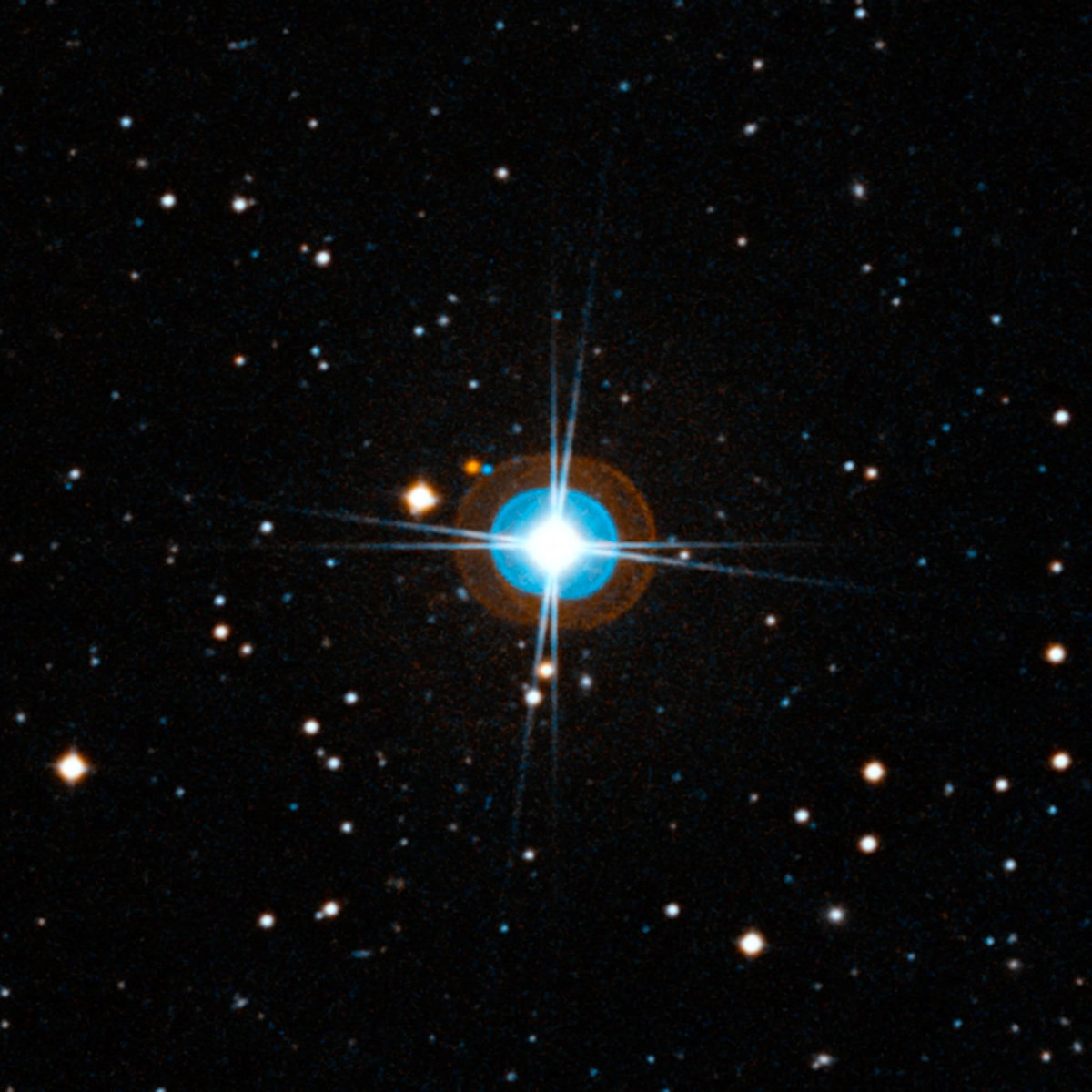
The upper picture shows the star HD 10180. The image is derived from photos taken through red and blue filters. The spikes and halos around the star are artifacts of the imaging process. Naturally, the planets are not visible in the image. They are too close to their parent star and too dim.
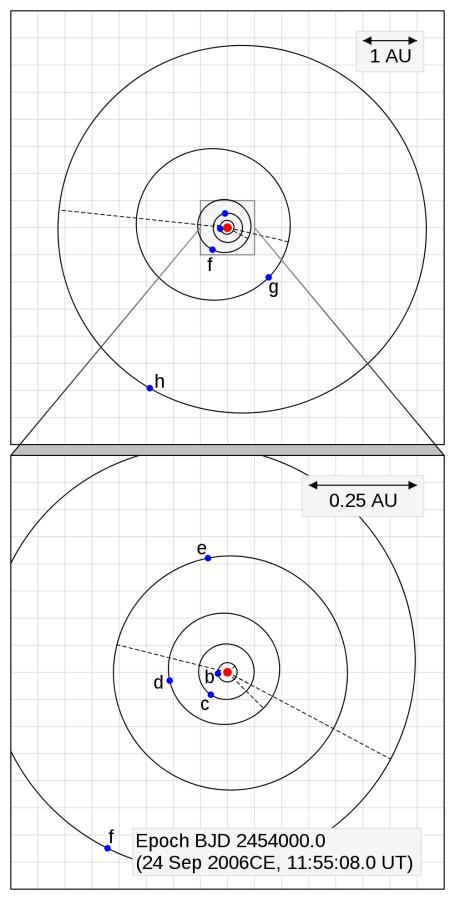
The lower diagram shows the possible orbits of the (up to) seven planets orbiting HD10180. The planets orbit at distances of 0.02, 0.06, 0.13, 0.27, 0.49, 1.42 and 3.4AU. All except the one closest to the star are much heavier than the Earth weighing in at between about 12 and 64 Earth masses. The ESO has a photograph of the star, but the planets are far to faint to be imaged with current technology.
The upper picture shows the star HD 10180. The image is derived from photos taken through red and blue filters. The spikes and halos around the star are artifacts of the imaging process. Naturally, the planets are not visible in the image. They are too close to their parent star and too dim.
The lower diagram shows the possible orbits of the (up to) seven planets orbiting HD10180. The planets orbit at distances of 0.02, 0.06, 0.13, 0.27, 0.49, 1.42 and 3.4AU. All except the one closest to the star are much heavier than the Earth weighing in at between about 12 and 64 Earth masses. The ESO has a photograph of the star, but the planets are far to faint to be imaged with current technology.
HD 10180
| Planet | Description (in order from the star; all quoted values are approximate) |
| HD 10180 b | This planet was confirmed in 2012. It is believed to be at least 40% heavier than the Earth. However, it is not very hospitable being only a little more than 3.3 million km (2 million miles) from the star, orbiting approximately once every 26½ hours. |
| HD 10180 c | This planet is about 13.1 times heavier than the Earth; just a little less than Uranus. It is about 9.6 million km (6 M miles) from HD 10180, which it orbits every 5.76 days. |
| HD 10180 i | This planet remains unconfirmed. Its mass is estimated to be somewhere less than 3.7 Earth masses, and it orbits about 13.5 million km from its star every 9.66 days. It was identified as a candidate in 2012. |
| HD 10180 d | This planet is about 11.75 times heavier than the Earth. It is about 19.2 million km (12 M miles) from HD 10180, which it orbits every 16.36 days. |
| HD 10180 e | This planet is about 25.1 times heavier than the Earth; about 1.5 times as heavy as Neptune. It is about 40.4 million km (25.2 M miles) from HD 10180, which it orbits every 49.75 days. |
| HD 10180 j | This planet remains unconfirmed. Its mass is estimated to be somewhere around 5.1 Earth masses, and it orbits a little over 49 million km from its star every67.55 days. |
| HD 10180 f | This planet is about 23.9 times heavier than the Earth. It is about 73.7million km (40.6 M miles) from HD 10180, which it orbits every122.88 days. |
| HD 10180 g | This planet is about 21.4 times heavier than the Earth. It is about 212.7 million km (133 M miles) from HD 10180, which it orbits every 596 days. |
| HD 10180 h | Recently confirmed, this is about 64.4 times heavier than the Earth; about 1.5 times as heavy as Saturn. It is about 522 million km from HD 10180, which it orbits every 6 years and 110 days. |