

Solar System -
Saturn
A brief video about Saturn's Ring System
A comprehensive description of the rings system
The ring system, details of the missions to Saturn, and a huge portfolio of photographs
A comprehensive description of the rings system
The ring system, details of the missions to Saturn, and a huge portfolio of photographs
Saturn's Rings
I am sure that anyone reading this is aware of Saturn's spectacular ring system. It is likely that they are the result of the destruction of a small moon either through gravitational disruption or a collision with a comet or other object. Some astronomers suggest that they may have been leftover from when Saturn originally formed, but this seems much less likely. Most agree that the rings are very old; perhaps 4 billion years. As the rings are not solid, the speed at which they orbit Saturn reduces the further out one looks.
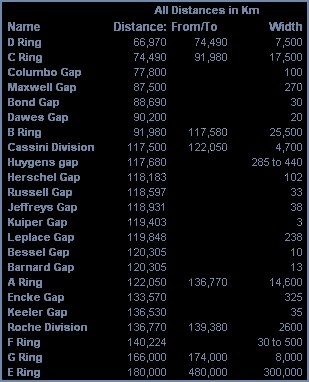
The structure of the rings is very complex, and we will discuss only some of the key features here. The table to the right is a reasonably comprehensive list of the components; distances are measured from the center of Saturn, not from the surface which is approximately 60,000 km (37,500 miles) from the center. Note that the maximum thickness of the rings is only about one kilometer (3,200 feet), and generally much less. Much more information can be gleaned from the links at the bottom of this page. In the main, the rings comprise objects up to a few cms across, but some can be up to several meters in size. They are composed almost entirely from water ice, with impurities comprising, perhaps, 0.1%.
Looking outwards from Saturn, the first ring is the very faint D ring. Next come the three main rings called C, B, and A. Narrow spaces between rings are called "Gaps" , while wider spaces are called "divisions". The Cassini Division separates Rings B and A, and is the largest gap in the ring structure. Next comes the narrow F Ring, lying just beyond the A Ring. Finally, there are two more very faint rings, the G and E rings. The rings are not continuous, and each ring comprises many gaps, some containing narrow sub-rings. There are also very faint narrow rings in the gaps and divisions between the rings.
The structure of the rings is very complex, and we will discuss only some of the key features here. The table to the right is a reasonably comprehensive list of the components; distances are measured from the center of Saturn, not from the surface which is approximately 60,000 km (37,500 miles) from the center. Note that the maximum thickness of the rings is only about one kilometer (3,200 feet), and generally much less. Much more information can be gleaned from the links at the bottom of this page. In the main, the rings comprise objects up to a few cms across, but some can be up to several meters in size. They are composed almost entirely from water ice, with impurities comprising, perhaps, 0.1%.
Looking outwards from Saturn, the first ring is the very faint D ring. Next come the three main rings called C, B, and A. Narrow spaces between rings are called "Gaps" , while wider spaces are called "divisions". The Cassini Division separates Rings B and A, and is the largest gap in the ring structure. Next comes the narrow F Ring, lying just beyond the A Ring. Finally, there are two more very faint rings, the G and E rings. The rings are not continuous, and each ring comprises many gaps, some containing narrow sub-rings. There are also very faint narrow rings in the gaps and divisions between the rings.
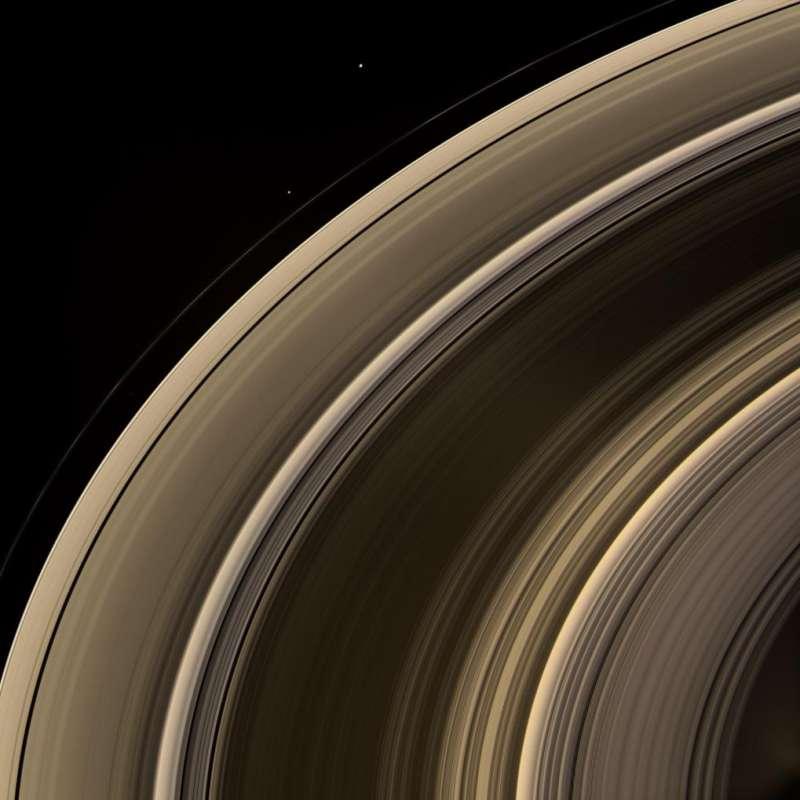
Part of Saturns rings. Image taken by the Cassini spacecraft.
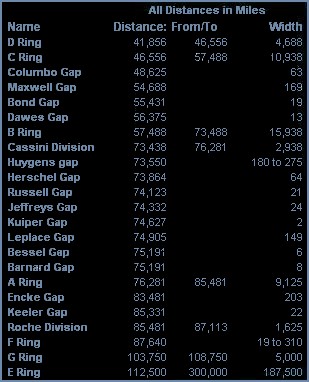
| Click to see table in miles |

Another Cassini image of Saturn's ring system in natural color. The rings and gaps, as well as other features like gravitational resonances and wave patterns, are all visible, as are the subtle variations in color. It is a mosaic of six images showing the rings from a radius of 74,565 km out to 136,780 km (46,333 to 84,991 miles) from the center of Saturn.
Some additional information on key features of the ring structure. Note that the characters identifying the rings were assigned in alphabetical sequence of their discovery, not their locations.
Links
Key Ring Components

Credit: NASA/JPL/Space Science Institute
Ring Structure
Close Up Images
| D Ring | Closest to Saturn, and very faint. Voyager 1 detected three ringlets within the D Ring named D73, D72 and D68. Cassini images show D72 as much fainter and 200 km closer to Jupiter. |
| C Ring | A wide, faint ring estimated at only 5 metres (16 feet) thick. |
| Colombo Gap | Embedded near the inner edge of the C Ring. |
| Maxwell Gap | Embedded near the outer edge of the C Ring. |
| B Ring | Unlike the C Ring, the B Ring has no gaps. It is the widest of all the rings, except the extremely nebulous outermost E Ring, and the brightest. Images from Voyager showed some previously unseen "spokes" running across the ring's diameter. Current theory explains them as microscopic dust particles held away from the ring by electrostatic repulsion. They are thought to be seasonal, appearing around the time of Saturn's equinox, then disappearing in summer and winter. There also appears to be a secondary periodic waxing and waning over a 29.7 year cycle coinciding with Saturn's orbit. |
| Cassini Division | Due to its width, the Cassini Division has been known since 1675. Particles on the inner edge of the Division are in a 2:1 orbital resonance with the moon Mimas resulting in a distinct edge rather than a progressive lowering of particle density. The Cassini Division comprises a series of gaps separated by very faint rings, including the Huygens, Herschel and Leplace Gaps amongst many others. |
| A Ring |
Another large, bright ring, estimated at 10 to 30 metres thick. The A Ring extends outwards from the Cassini Division to the orbit of Saturn's moon Atlas. Over 150 very small moons, around 100 metres across, have been found in the Ring, causing strange "propeller" shaped disturbances. The Ring contains two notable gaps, the Encke Gap, caused by the orbit of the moon Pan, and the narrower Keeler Gap, caused by the moon Daphnis. Particles at the outer edge of the A Ring are in a 7:6 resonance with the moons Janus and Epimetheus, again leading to an abrupt cutoff for the Ring edge. |
| Roche Division | A wide division between the A Ring and the F Ring. It contains a sheet of tenuous material. |
| F Ring |
A narrow but highly dynamic ring, that is maintained by the two shepherd moons Prometheus at the inner edge, and Pandora the outer edge. The material of the ring gyrates with knots and twists caused by the gravitational interactions with the shepherd moons, as well as, possibly, a number of very small moonlets. |
| G Ring | While faint and fairly narrow, the G Ring has a bright arc near its inner edge, some 250 km across and extending about 60 degrees around the circumference of the ring. It is centered on the small moon Aegaeon. Dust erupts from the surface of Aegaeon from meteoroid impacts and replaces the material in the arc that is lost. Similar arcs have been found near the moons Methone, Anthe and Pallene. |
| E Ring | The widest ring starts near the orbit of Mimas and extends almost to the orbit of Rhea. The moon Enceladus orbits within the ring, and is thought to contribute the material of the ring from the eruptions known ro occur at its south pole. |