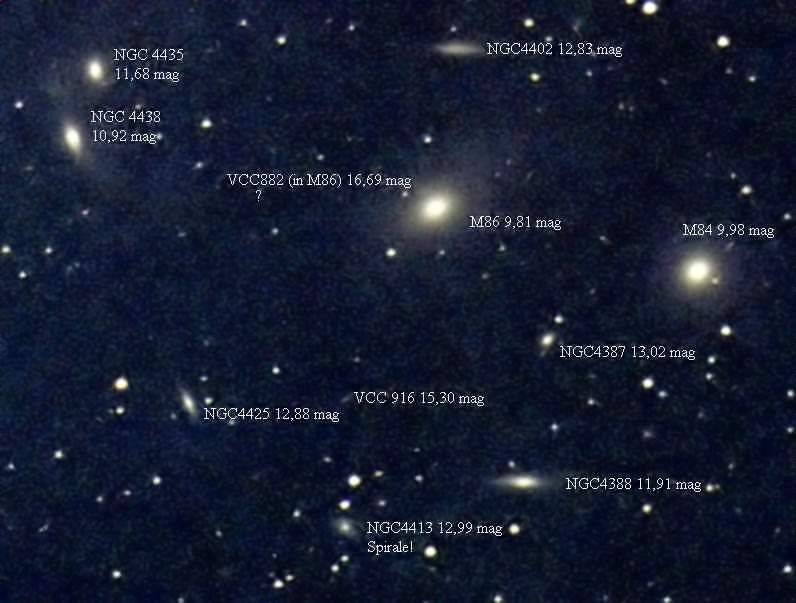
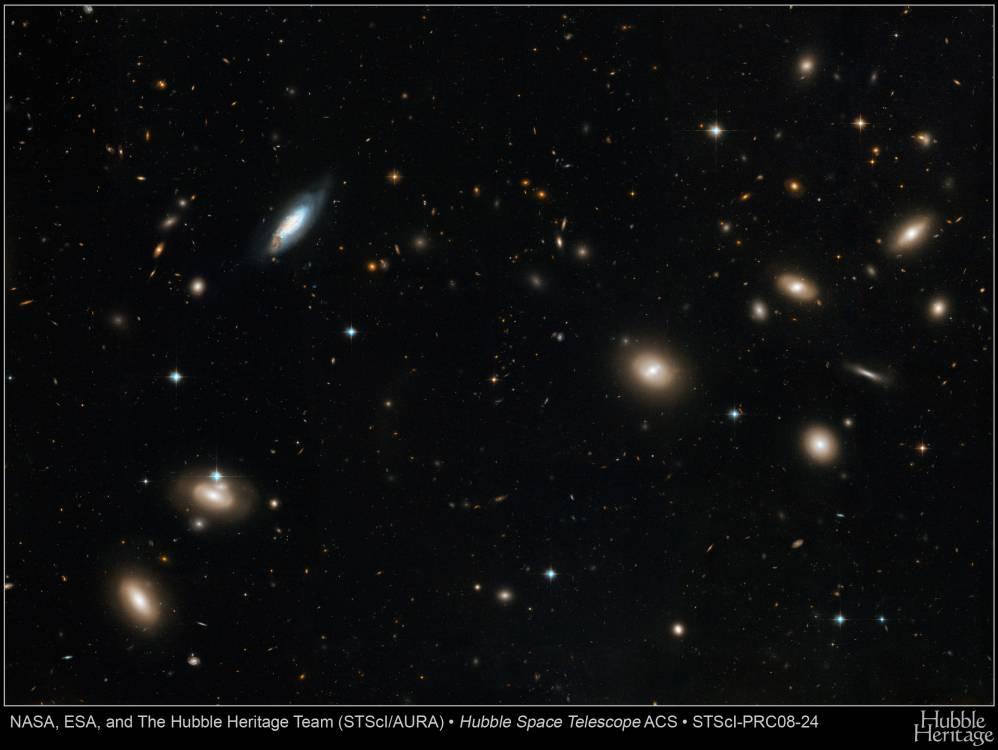
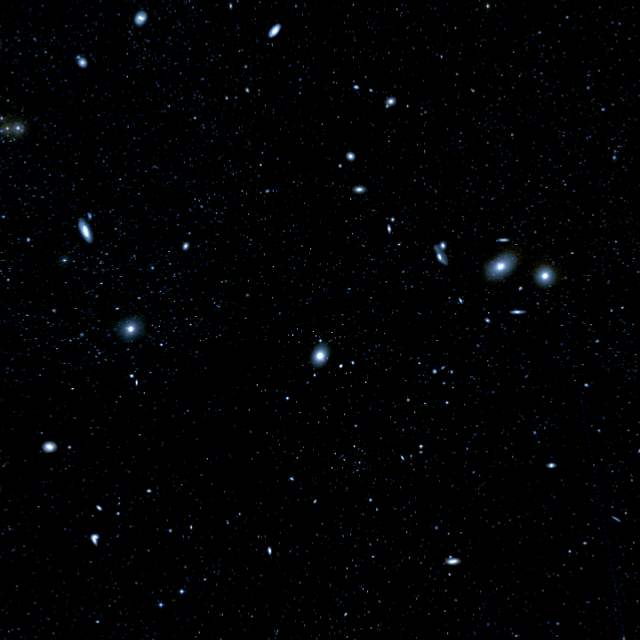
A large cluster, Virgo contains about 1,500 galaxies, and possibly as many as 2,000 as it includes a large number of faint, dwarf galaxies. About 90% of the known galaxies in Virgo are dwarfs. At about 5 Mpc across, it is not much larger in volume than the Local Group, but contains about 50 times as many galaxies. It is about 18 Mpc away, and is part of the Virgo Supercluster, which is also known as the Local Supercluster, which also includes our own Local Group of galaxies. The Virgo cluster comprises three main groups of galaxies gathered around three large galaxies designated M87, which is associated with the largest of these groups, M86, and M49. As is usual in clusters, the elliptical galaxies tend to be in the inner part of the cluster, while spirals and dwarfs are spread throughout the cluster. Here is a movie "Flight to the Virgo Cluster" which is well worth a look; visually stunning; though at 25MB, you need a fast internet connection.

This section looks at groups and clusters of galaxies in the Universe. This involves scales up to megaparsecs; that is, millions of light years. Let us consider our own Galaxy; the Milky Way. It is part of what is known as the Local Group of galaxies which comprises around 45 galaxies. The three largest galaxies in the Local Group are the Milky Way, Andromeda and Triangulum, which is much smaller than the other two. These three are the only spiral galaxies. About half of the remaining galaxies are satellites of the Milky Way and Andromeda. The group is approximately 3 Mpc in diameter (around 10 million light-years) and is shaped roughly like a dumbbell.
Generally, group is used to describe collections of up to 50 galaxies, and Cluster is used for collections of 50 to 1,000 or more individual galaxies. Groups are typically a few Mpc in their largest dimension, while a cluster could be 10 Mpc or more across. These are certainly not strict rules. Approximate composition by mass is:
• 5% visible matter; that is, stars and dust in the various galaxies
• 10% hot gas
• 85% dark matter.
The proper motions of the galaxies in a group tends to be of the order of 100 miles/second, while in clusters, it is much greater; around 500 to 650 miles/second. This implies that the gravitation binding of the galaxies in a cluster is looser than it is in a group. Nevertheless, in both cases, outlying galaxies are much more susceptible to being pulled away than those closer to the center. In the same way that galaxies collide with each other, this also happens with groups and clusters. Generally, it seems that when this happens, the two components ultimately remain separate, passing through each other, but some galaxies would "change allegiance" in the process. This link is brief, but contains additional useful links that discuss the grouping of galaxies.
Here are descriptions of a few typical groups and clusters.
Generally, group is used to describe collections of up to 50 galaxies, and Cluster is used for collections of 50 to 1,000 or more individual galaxies. Groups are typically a few Mpc in their largest dimension, while a cluster could be 10 Mpc or more across. These are certainly not strict rules. Approximate composition by mass is:
• 5% visible matter; that is, stars and dust in the various galaxies
• 10% hot gas
• 85% dark matter.
The proper motions of the galaxies in a group tends to be of the order of 100 miles/second, while in clusters, it is much greater; around 500 to 650 miles/second. This implies that the gravitation binding of the galaxies in a cluster is looser than it is in a group. Nevertheless, in both cases, outlying galaxies are much more susceptible to being pulled away than those closer to the center. In the same way that galaxies collide with each other, this also happens with groups and clusters. Generally, it seems that when this happens, the two components ultimately remain separate, passing through each other, but some galaxies would "change allegiance" in the process. This link is brief, but contains additional useful links that discuss the grouping of galaxies.
Here are descriptions of a few typical groups and clusters.
Groups & Clusters


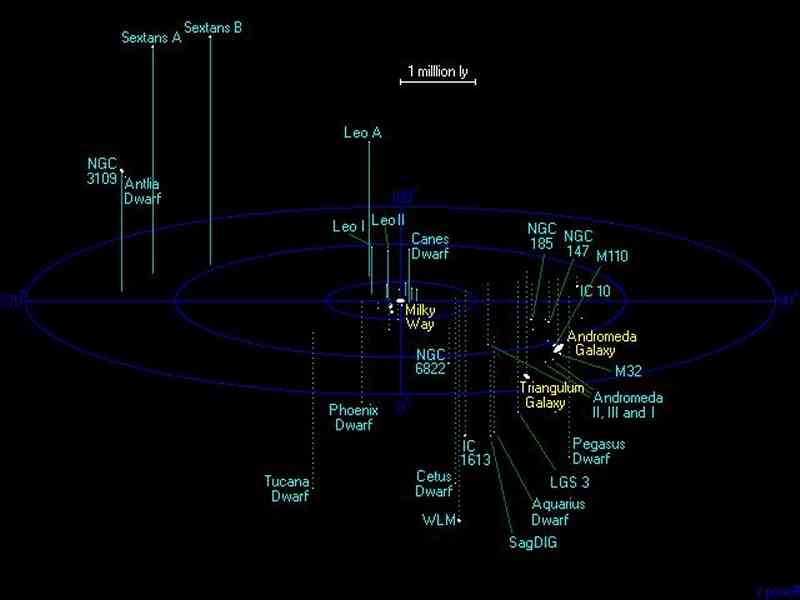
Our Local Group
Atlas of the Universe
Atlas of the Universe

Astronomy & Cosmology
-
Large Scale Structure of the Universe
Credit: Atlas of the Universe
Virgo Cluster
Abell 2151 (the Hercules Cluster)
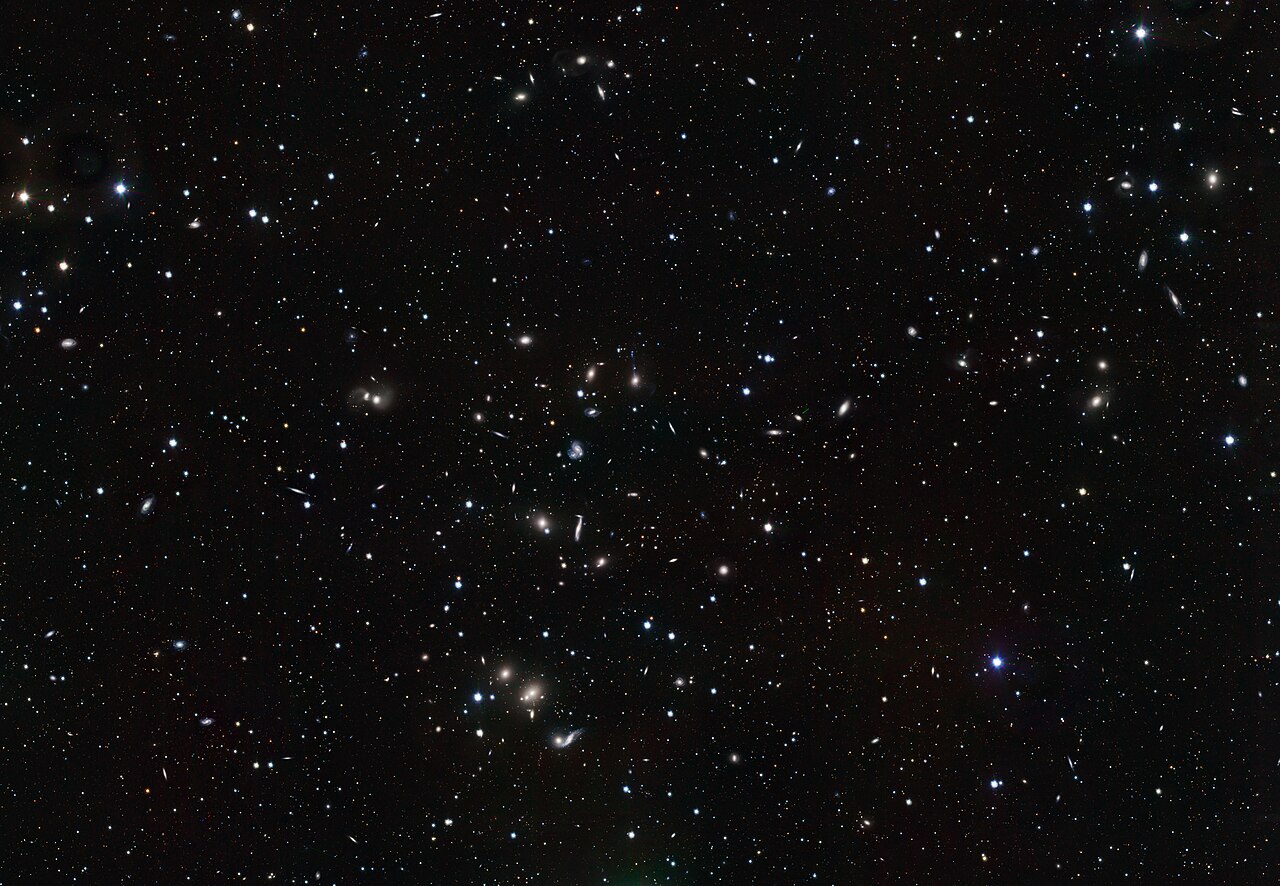
Abell 2151, or the Hercules Cluster, contains about 300 galaxies, including many outlying members, and is about 200 Mpc (c. 650 Million light-years) away. It is in the Hercules Supercluster, which is itself contained in the Great Wall; see Filaments & Walls. It is very rich in spiral galaxies, with a large number of interactions betweens its member galaxies. It appears very similar to some very distant galaxies, which we see when they were much younger. Thus, most astronomers agree that Hercules is a relatively young cluster.
Credit: NOAO/AURA/NSF
Coma Cluster
The Coma Cluster, another rich cluster, contains at least 1,000 galaxies and is about 100 Mpc away. In turn, it is in the Coma Supercluster, which contains more than 3,000 galaxies, and is in the central part of the Great Wall. Most of the galaxies are elliptical or lenticular, with two very large giant ellipticals NGC 4874 and, the largest, NGC 4889 which is approximately 500,000 light years in diameter; five times the diameter of the Milky Way.
Norma Cluster
Very similar in make up to the Coma Cluster, the Norma Cluster, Abell 3627, is hard to see in visible light as its position relative to the Milky Way means it is obscured by dust; in the southern "zone of avoidance". It is being investigated in infrared light that is able better to penetrate the dust and gas. It is the richest cluster in the Centaurus Supercluster, and is in the central area of the Great Attractor.
Fornax Cluster &
Eridanus Group
The Fornax Cluster is a small cluster of approximately 58 galaxies, much smaller than the Virgo Cluster, for example, located around 20 Mpc away. It contains two massive galaxies - NGC 1316, a lenticular, and NGC 1365, a barred spiral. Both are more than twice the diameter of the Milky Way. There is substantial evidence that one, or maybe two, sub-groups of galaxies have collided with the main group in the astronomically recent past. Associated with the Fornax Cluster, the Eridanus Group lies about 7 Mpc further away. It contains around 200 galaxies, is approximately 10 Mpc across, and about 23 Mpc away. This grouping is in the early stages of formation, and with the Fornax cluster, the Dorado group and others, forms the Eridanus-Fornax-Dorado Filament. It is very interesting because although many of its constituent galaxies are quite old, the group itself is rather young and still forming. It also has a large number of lenticular (type S0) galaxies. These are believed to be part of the evolution of spiral galaxies again implying great age for many of the galaxies.
The Abell 370 Cluster
a large cluster about 6 billion light years away. It comprises several hundred galaxies, and is the most distant cluster catalogued by George Abell. In the Image of the galaxy (right), you can see arcs of light, which are the result of gravitational lensing by Abell 370 of more distant objects. One of them is the galaxy HCM-6A, which, at around 12.8 billion light years away, is one of the furthest known galaxies. The center image shows the cluster, while the two outer images are details of the indicated parts of the image showing some of the gravitationally lensed galaxies behind the cluster. Click to expand any of the images. Clicking on the boxes or arrows will take you to the appropriate detailed image.
Central region of the
Fornax Cluster. ESO
Fornax Cluster. ESO


Pandora's Cluster - Abell 2744
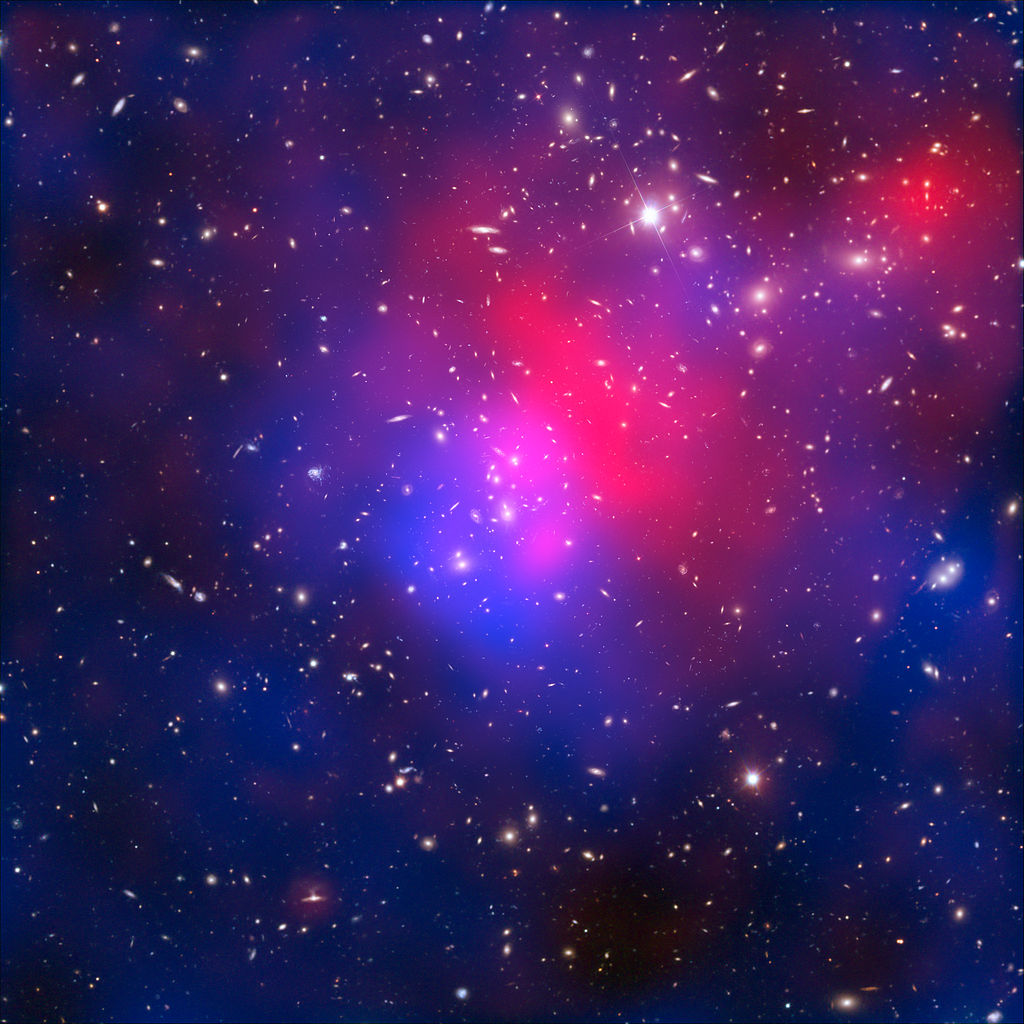
Abell 2744 is a huge galaxy cluster that is the result of a collision between four or more smaller clusters. The collision occupied a period of around 350 million years. The picture to the right is made up of images from the Hubble Space Telescope, the Chandra Space Telescope, the Very Large Telescope (ESO), and the Japanese Subaru telescope. 75% of the mass in the cluster is in the form of dark matter, while 20% is hot gas, leaving only 5% for the visible galaxies. The team plotted how Abell 2744 distorted the images of galaxies behind due to gravitational lensing to plot the mass concentrations both visible and as dark matter. This is shown in the blue areas of the image. The hot gas, which is visible only in the X-Ray images from Chandra, is shown in red. White to yellow represents the visible spectrum. The image covers a region about 1.8 Mpcs square, and the cluster is more than one Gpc (about 3.5 billion light-years) away from us at a red shift of 0.308. Credit: NASA, ESA & STScI