Voids & Supervoids
Cosmic voids, and supervoids, are large volumes of space that are devoid of matter. This includes normal matter, in the form of galaxies, and dark matter. Initially, astronomers were not sure if the voids contained dark matter, even though there were no galaxies, but recent observations show that the halos of dark matter are not present. The filamentary structure of galactic superclusters surrounds the voids. While space is mostly empty, voids are large volumes, tens of megaparsecs across. The largest confirmed supervoids are about 100 Mpc (325 million light-years) or more across . The larger known voids include the Boötes Supervoid, and the Northern and Southern Local Supervoids. To explain the cold spot in the cosmic microwave background (CMB), some astronomers propose a huge supervoid, tentatively dubbed the Eridanus or Great supervoid. The Capricornus void is another disputed void, but would be around 230 Mpc across. This link has some of the latest information on cosmic voids. Here is some information on some of the voids and supervoids identified so far:

Astronomy & Cosmology
-
Large Scale Structure of the Universe
Local Void
The Local Void is very large at approximately 60 Mpc long, and is located within the Virgo Supercluster. Our own Local Cluster of galaxies lies on the edge of the void. The dwarf galaxy Eso 461-36 lies within the void, but appears to be moving towards the boundary at around 216 km/second (135 miles/sec). In addition, the Milky Way has been found to have three main components to its motion; two are attractive, towards the "great Attractor" at 455 km/second and the Virgo Cluster at 185 km/second, and one repulsive, away from the local void at approximately 260 km/second.
The Local Void is very large at approximately 60 Mpc long, and is located within the Virgo Supercluster. Our own Local Cluster of galaxies lies on the edge of the void. The dwarf galaxy Eso 461-36 lies within the void, but appears to be moving towards the boundary at around 216 km/second (135 miles/sec). In addition, the Milky Way has been found to have three main components to its motion; two are attractive, towards the "great Attractor" at 455 km/second and the Virgo Cluster at 185 km/second, and one repulsive, away from the local void at approximately 260 km/second.
Boötes Void
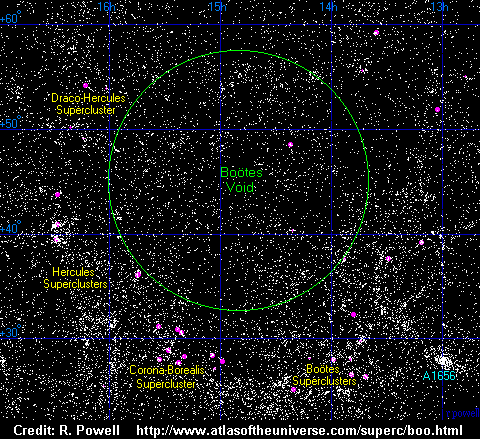
The center of the Boötes void, also known as the Great Void, is about 215 Mpc away from the Milky Way. It is a near spherical region of space, some 75 to 100 Mpc across. It contains a much lower density of galaxies than expected, and to date, only about 60 galaxies have been found in the void, although there are probably more dwarf galaxies not yet detected. Consider that the distance to our nearest large galaxy, Andromeda, is only 1% the diameter of the Boötes void, you would reasonably expect to find many more galaxies in that volume of space. Assuming an average galaxy spacing of 10 million light-years, four times the distance to Andromeda, there would be approximately 2,000 galaxies in a volume of space the size of the Boötes void. It is interesting in that the galaxies found are in a "tube" like area that runs through the void, leading to the hypothesis that it formed as the merger of a number of smaller voids. The astronomer Greg Aldering has said, “If the Milky Way had been in the center of the Boötes void, we wouldn’t have known there were other galaxies until the 1960s” such is the low density. However, the galaxies that have been found are brighter, on the average, than galaxies found outside of voids, which is perplexing. In the image to the right, the galaxies seen within the circle are foreground galaxies, and not in the void that lies behind them.
Taurus Void
The Taurus Void is circular, about 30 Mpc across, and adjacent to the Perseus-Pisces Supercluster. A few galaxies have been found inside it including UGC 2627 and UGC 2629 (left) which are approximately 185 million light years away; see image to the left (no larger version).
Eridanus Supervoid or Great Void
The Eridanus Supervoid, or Great Void, is conjectural, and has been suggested as a way to explain the "cold spot" in the cosmic microwave background radiation, or CMB. This would be an extraordinarily large region of the universe, at least 150 Mpc or 500 million light-years across, and possibly twice this figure. It is also very distant at between 1.8 Gpc and 3 Gpc (6 to 10 billion light-years). Many astronomers and cosmologists do not accept the supervoid theory for the aberration in the CMB, but many of the alternatives are even more astounding including cosmic textures and parallel universes. So the jury remains out on this one.


