Recombination -
380,000 Years
Astronomy & Cosmology -
The Early Universe
(or "What Banged in the Big Bang?")


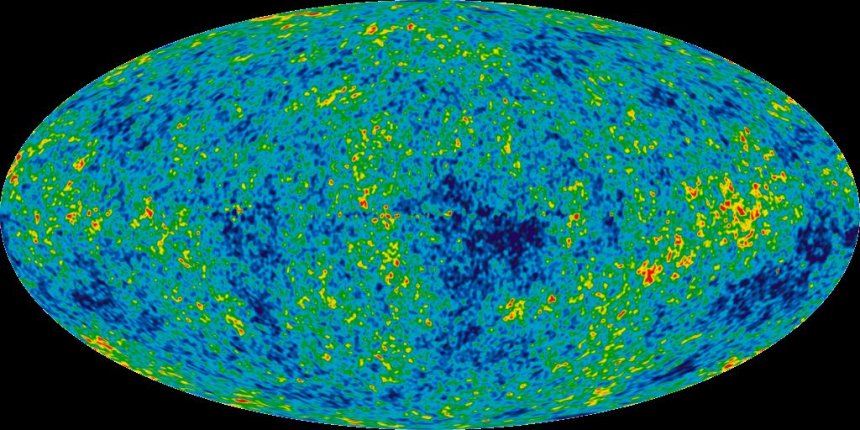
At this point, corresponding to a redshift of approximately 1,100, the universe is filled with an opaque plasma of ionized hydrogen and helium. That is, the positively charged atomic nuclei and negatively charged electrons cannot combine to form atoms as they are constantly bombarded by highly energetic photons. Once the temperature of the Universe cools down to below around 3,000K, hydrogen and helium ions are able to capture electrons creating neutral atoms in a process called recombination. Because the atoms are neutral, photons can no longer interact strongly with the nuclei, they become decoupled in a process called Photon Decoupling, and begin to move freely, resulting in a transparent Universe. The expansion of the fabric of space since then has progressively increased the wavelength of this photon background light, reducing the frequency to the microwave background radiation we see today at a temperature of approximately 2.7K. This is shown in this WMAP image of the Cosmic Microwave Background that we observe today. It is the remnant of the epoch of last scattering; about 380,000 years after the Big Bang. The image above shows the most recent analysis of the WMAP data in 2012.
Starting from this recombination process, the Universe enters the Dark Ages. The Universe is transparent, but there is not much to see! After recombination, the Universe would be relatively homogenous with very small deviations. The slightly denser areas would start to collapse under gravity, and after about 150 million years, the first population III stars (which are the very earliest stars) and the quasars start to form. This marks the start of the end of the Dark Ages, and the beginning of reionization, which is the subject of the next section.
Starting from this recombination process, the Universe enters the Dark Ages. The Universe is transparent, but there is not much to see! After recombination, the Universe would be relatively homogenous with very small deviations. The slightly denser areas would start to collapse under gravity, and after about 150 million years, the first population III stars (which are the very earliest stars) and the quasars start to form. This marks the start of the end of the Dark Ages, and the beginning of reionization, which is the subject of the next section.