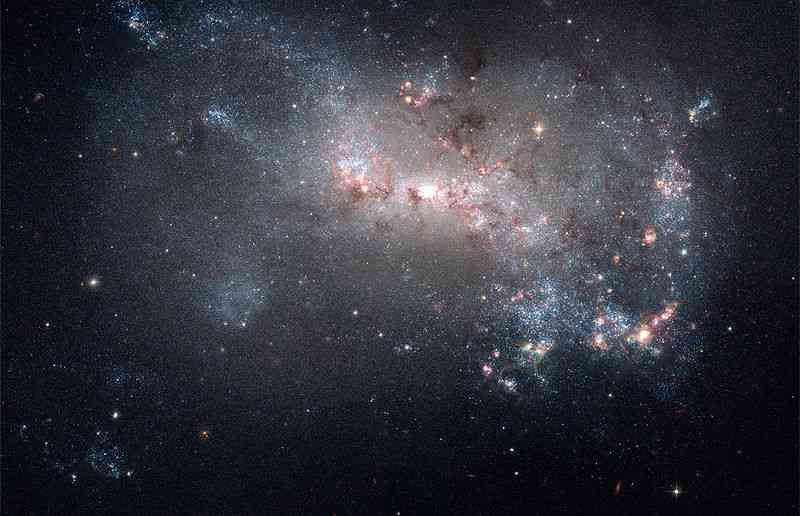
About 12.5 million light-years away, NGC4449 is a dwarf irregular galaxy. It is in the Canes Venatici I (or M94) Group of galaxies, which is one of groups in the Virgo Supercluster, Local Supercluster, and is one of our closest clusters. It was probably once a dwarf barred spiral galaxy that was disrupted by other nearby galaxies as it is possible to see the remnant of a bar in its center in the picture to the left. The galaxy is also categorized as a Starburst Galaxy because of the intense rate of new star formation that has been ongoing for several billion years. Throughout the body of the galaxy it is possible to see hundreds of thousands of bright stars. This star formation was probably triggered by the same interactions with other galaxies that caused the disruption to its structure. It is very similar in size to the Large Magellanic Cloud, see below.
| Irr-I galaxy | TE | has some structure but not enough to identify it as a disk or elliptical. |
| Irr-II galaxy | does not have any identifiable structure. | |
| dI or dIrrs galaxy | dwarf irregular galaxies. They tend to have a low level of heavier elements, and relatively high levels of gas, and are thought to be similar to the galaxies that formed early in the life of the Universe. They may be similar to the faint blue galaxies that have been found in deep field galaxy surveys. |
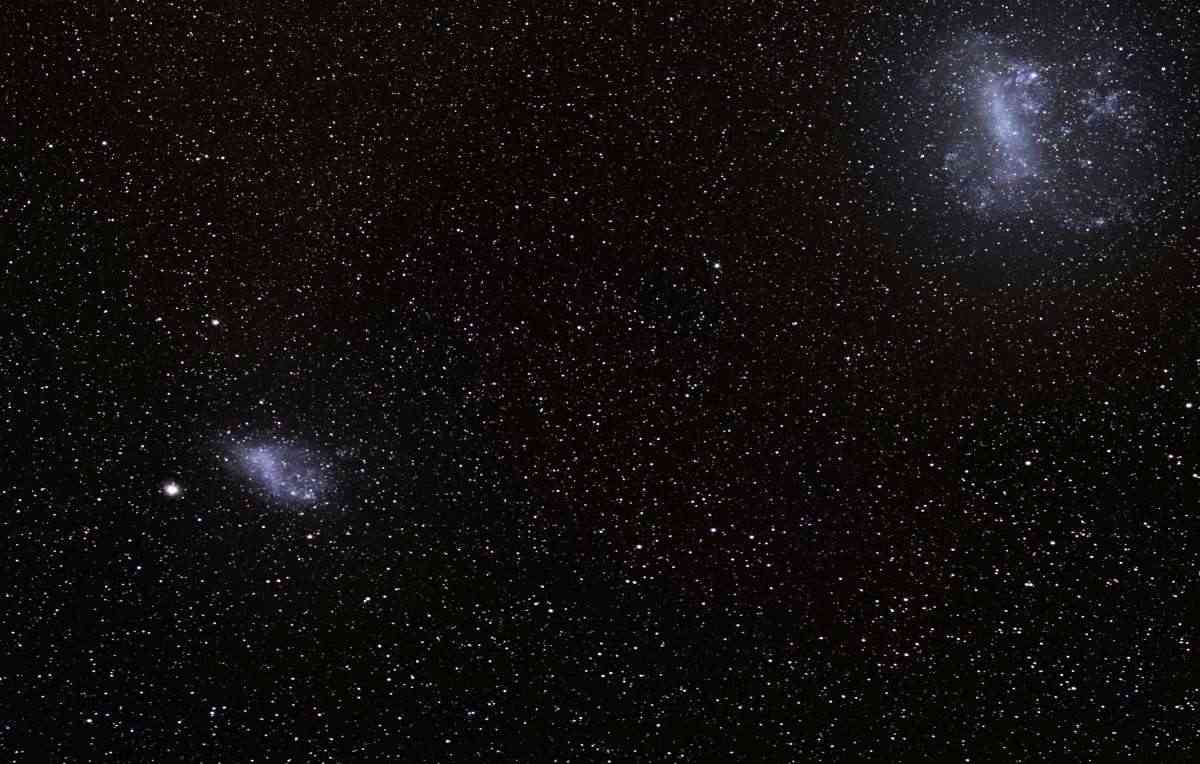
Irregular galaxies have no discernable structure, in the way that spiral or elliptical galaxies have; they are just a fuzzy agglomeration of stars. They do not fall into any of the regular classes of the Hubble sequence, and they are often chaotic in appearance, with neither a central bulge nor any trace of spiral arm structure. Good examples are the two dwarf galaxies comprising the Magellanic clouds around 179,000 light-years away that orbit the Milky Way. While there are some very large irregular galaxies, they tend to be smaller usually less than 25% the size of the Milky Way. They also tend to contain many new stars, with a lot of current new star formation. Collectively they are thought to make up about a quarter of all galaxies. Most irregular galaxies were once spiral or elliptical galaxies but were deformed by gravitational action from nearby large galaxies. Irregular galaxies may also contain abundant amounts of gas and dust. These are the broad categories of irregular galaxy:
Irregular Galaxies
Canis Major Dwarf Galaxy
Astronomy & Cosmology -
Galaxies


Large Magellanic Cloud
NGC4449 - Caldwell 21
Credit NASA,
ESA and HST
ESA and HST
Sagittarius Dwarf Irregular Galaxy
The Large Magellanic Cloud is another galaxy, very similar to NGC 4449, that has a pronounced central bar, and probably started as a Barred Spiral, and became disrupted by interactions with the Milky Way and the Smaller Magellanic Cloud; see picture to the right. It is about 1/7th the diameter of the Milky Way (14,000 light-years) with about 10% of the mass. It contains at least one billion stars, and large quantities of dust and gas leading to the current wave of intense star formation. Despite its relatively small size, the LMC contains about 60 known globular clusters, 400 planetary nebulae, and 700 open clusters, along with hundreds of thousands of giant and supergiant stars.
The Canis Major Dwarf galaxy is an irregular galaxy, and, if it really exists, is probably the closest galaxy to our location in the Milky Way, though not the closest to the center of the Milky Way. It is about 25,000 light-years away from the Earth and 42,000 light-years from the center of the Galaxy. It could contain up to one billion stars, with an unusually high proportion of red stars. It seems that gravitational interaction with the Milky Way is pulling the Canis Major dwarf apart, and seems to have caused it to leave a long trail of stars as it orbits the Milky Way. This trail appears to wrap around the Milky Way three times, and has come to be known as the Monoceros Ring. There is, however, some debate over whether the Canis Major Dwarf Galaxy is just an artifact within the Milky Way. Its small size and location behind the plane of the Milky Way make it very difficult to observe. As the Orion Spur extends in the same direction, some observers suggest that this causes an over-density in the region that has been misinterpreted as a dwarf galaxy. Further, it is possible to interpret the Monoceros Ring as a part of the Milky Way's galactic disk. I will try and keep up with the latest developments.
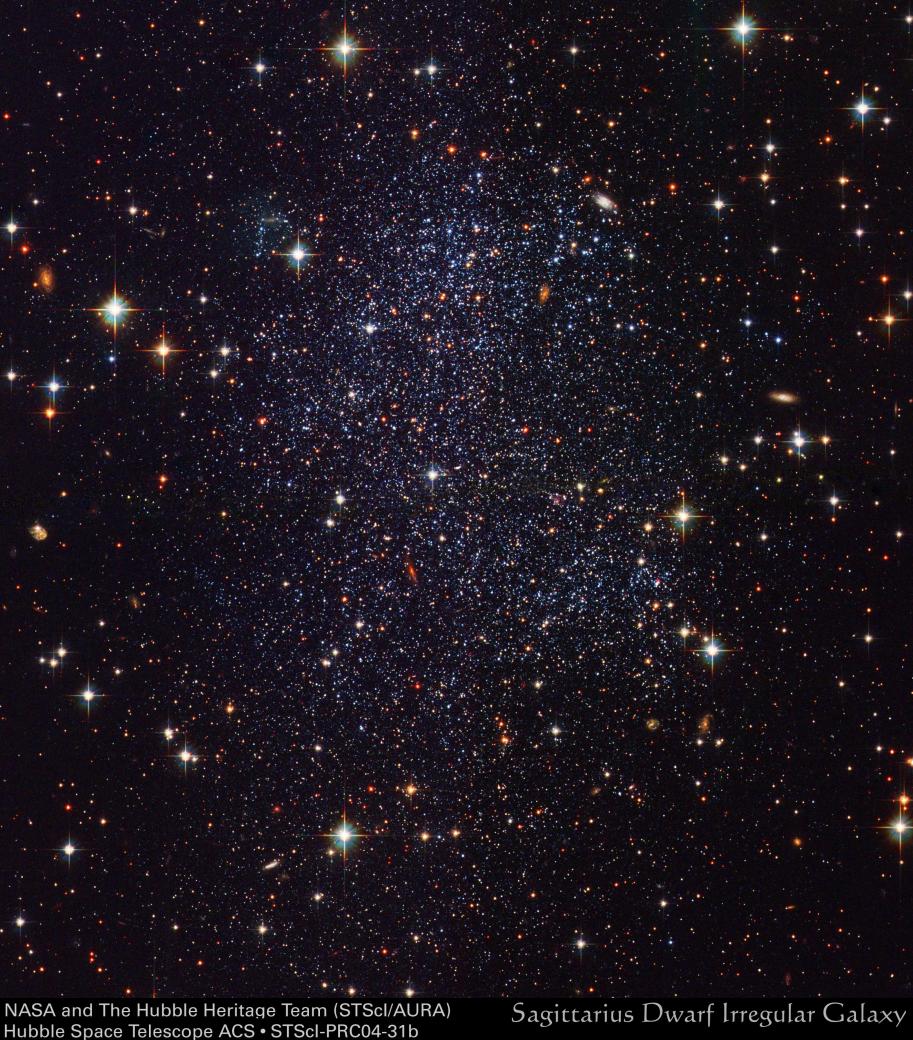
Located a little over 1 Mpc (3.4 million light-years) away, the Sagittarius Dwarf Irregular Galaxy, also known as SagDig, is the member galaxy furthest from the center of mass of our Local Group of galaxies. The very bright stars in the picture, those with spikes around them, are stars in the foreground belonging to the Milky Way. The main body of SagDig is rich in gas, and contains many regions of active star formation. Indeed, the average age of the stars in the galaxy is a relatively young 4 to 8 billion years.