In this section, we take a look at stars; how they form, how they evolve over millions or billions of years, and how they die. Of course, not all stars are the same, particularly in terms of their masses and sizes, so they do not share a common "lifestyle" or a common death. Thus we look at how these different stars behave. Astronomers categorize stars, at the first level, by their size and luminosity; or how bright they are. The Apparent Luminosity is the brightness as seen from the Earth. Because their distances from us vary enormously, this tells us nothing about how bright they really are. Their Intrinsic Luminosity is how bright they would appear if they were at a standard distance of 10 parsecs (about 33.6 light years) away, which is a far more useful measure. Of course, to calculate these values, we need to know how far away a star is. Also, different stars are luminous at different wavelengths; sometimes well outside the visible spectrum. So, in addition to the visible component, they may emit energy, sometimes massive amounts, in infra-red, ultra-violet, x-rays, gamma rays etc.
I do not feel that describing stars as being so many miles or km across, or weighing so many kilos or pounds, really gives a flavor of their size. Thus, I generally give sizes and masses with respect to the Sun. So I could define the star La Superba (Y Canum Venaticorum) as being three times the mass of our Sun, or three solar masses, and being 215 times the Sun's diameter, 215 times as "big". Of course, as the volume of a sphere is proportional to the cube of the radius, La Superba is nearly one million times the volume of the Sun. This means that the volume of VY Canis Majoris, the largest known star, is about eight billion times that of the Sun. The heaviest known star is R136a1, discovered in 2010 in in the Tarantula Nebula in the Large Magellanic Cloud. It weighs in at an incredible 265 solar masses. It is only about one million years old, and has already lost about 20% of its mass, so it started off at around 320 solar masses. There are some big stars out there!
It is interesting to see how vastly different stars can be even when they share a number of characteristics. Type K stars, for example, can include stars smaller than the Sun up to stars like Gamma Aquilae that is more than 100 times the size of the Sun. Type G, stars like our Sun, includes Groombridge 1830, with only 60% the mass and 64% the diameter of the Sun, and Xi Puppis, with ten times the mass and 120 times the diameter of the Sun. Then you have massive stars like the Wolf-Rayet type, part of the evolutionary process of extremely massive stars, that blow off the equivalent of the entire mass of the Sun every 100,000 years in a fierce stellar wind. The Types T, and possible Type Y, brown dwarfs can be only 1% or 2% the mass of the sun and glow at temperatures cooler than the charcoal in your barbeque!
The list of different types of star is vast, and I do not cover everything here. The internet is a wonderful source of information, but beware of sites that are not up to date. Try this NASA site for a very basic introduction. It also explains how we are truly made from star dust! This Cornell site also has a brief overview. Keele University has a very interesting overview of the entire life of a star of one solar mass, and one of ten solar masses. The University of California has a rather more technical treatment of the evolution of stars similar to the sun, and another for massive stars. Finally, try building and evolving a star or two using Star in a Box; it's great fun.
I do not feel that describing stars as being so many miles or km across, or weighing so many kilos or pounds, really gives a flavor of their size. Thus, I generally give sizes and masses with respect to the Sun. So I could define the star La Superba (Y Canum Venaticorum) as being three times the mass of our Sun, or three solar masses, and being 215 times the Sun's diameter, 215 times as "big". Of course, as the volume of a sphere is proportional to the cube of the radius, La Superba is nearly one million times the volume of the Sun. This means that the volume of VY Canis Majoris, the largest known star, is about eight billion times that of the Sun. The heaviest known star is R136a1, discovered in 2010 in in the Tarantula Nebula in the Large Magellanic Cloud. It weighs in at an incredible 265 solar masses. It is only about one million years old, and has already lost about 20% of its mass, so it started off at around 320 solar masses. There are some big stars out there!
It is interesting to see how vastly different stars can be even when they share a number of characteristics. Type K stars, for example, can include stars smaller than the Sun up to stars like Gamma Aquilae that is more than 100 times the size of the Sun. Type G, stars like our Sun, includes Groombridge 1830, with only 60% the mass and 64% the diameter of the Sun, and Xi Puppis, with ten times the mass and 120 times the diameter of the Sun. Then you have massive stars like the Wolf-Rayet type, part of the evolutionary process of extremely massive stars, that blow off the equivalent of the entire mass of the Sun every 100,000 years in a fierce stellar wind. The Types T, and possible Type Y, brown dwarfs can be only 1% or 2% the mass of the sun and glow at temperatures cooler than the charcoal in your barbeque!
The list of different types of star is vast, and I do not cover everything here. The internet is a wonderful source of information, but beware of sites that are not up to date. Try this NASA site for a very basic introduction. It also explains how we are truly made from star dust! This Cornell site also has a brief overview. Keele University has a very interesting overview of the entire life of a star of one solar mass, and one of ten solar masses. The University of California has a rather more technical treatment of the evolution of stars similar to the sun, and another for massive stars. Finally, try building and evolving a star or two using Star in a Box; it's great fun.
Introduction
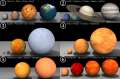
Credit: Dave Jarvis
Astronomy & Cosmology -
Stars


The image to the right gives an interesting comparison of the sizes of some of our planets, the sun and various other stars.
In round numbers:
The Earth's diameter is 12,750 km (7,900 miles).
The sun is 1,392,00 km (870,000 miles) across.
VY Cannis Majoris is 2 Billion km (1.25 Billion miles) across!
The Earth's diameter is 12,750 km (7,900 miles).
The sun is 1,392,00 km (870,000 miles) across.
VY Cannis Majoris is 2 Billion km (1.25 Billion miles) across!