
History
With the completion recently of what is probably the last Hubble upgrade, I though it appropriate to have a page dedicated to its' history, its' achievements and some of the beautiful images it has produced. In addition to taking amazing photographs, observations have contributed enormously to our knowledge of the cosmos; for example, determining the rate at which the Universe expands, and contributing to the finding that the rate of expansion of the Universe is increasing, the so-called accelerating Universe, rather than decreasing as previously believed. Its observations have helped to fix more accurately the probable age of the Universe as well as its constituents in terms of matter, dark matter and dark energy. Note that mages on this page are NASA, ESA, Hubble unless stated otherwise.
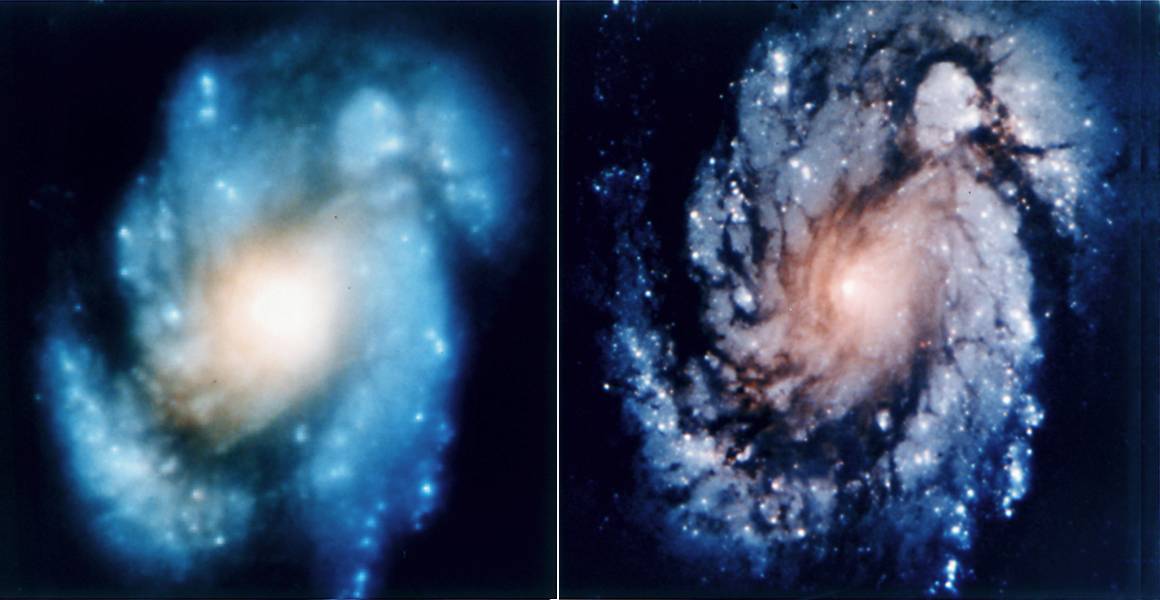
In 1977 the U.S. Congress voted to fund construction of the Hubble Space Telescope, and it was completed in 1985. It is named for the astronomer Edwin Hubble who was the first scientist to recognize the overall expansion of the Universe, and to relate the red-shift in the light from distant objects to their distance from us. The telescope was deployed on April 25th 1990. Once it started operation, the mirror was found to have a tiny flaw that had a huge impact on the image quality.
Thus, in 1993, NASA sent a mission to instal a corrective mechanism, called COSTAR (the Corrective Optics Space Telescope Axial eplacement), which was a complete success. They also installed a new Wide Field Planetary Camera, along with several new components.
Another Mission, launched on February 11, 1997, installed a wide range of new instruments to extend the telescopes range into the near infrared, thus increasing substantially the range of the telescope. Following this very successful mission, NASA decided to extend the planned operational window of the telescope from 2005 to 2010.
On November 13, 1999, the fourth of six on-board gyroscopes failed, so the telescope went into safe mode as it was unable to work without a minimum of three. Along with replacement gyroscopes and a new computer, a number of other enhancements were installed in December of 1999.
March 2002 saw the fourth maintenance mission to instal the Advanced Camera for Surveys (ACS). This comprises a set of three cameras each having specialized capabilities. Overall, they have ten times the power of the camera they replaced, and cover wavelengths from the visible spectrum out to the far ultraviolet. Some of the aims of the new cameras are to photograph the inner regions of galaxies, search neighboring stars for planets and proto-planets, to study weather on planets in our solar system, and to study distant galaxies in much more detail.
The most recent, and almost certainly the last, maintenance mission was in May 2009. This saw the installation of two new scientific instruments: the Cosmic Origins Spectrograph (COS) and the Wide Field Camera 3 (WFC3). Two existing instruments were repaired along with the installation of new batteries, gyroscopes and computer. The success of the mission prompted NASA to extend operations to 2014.

Deep Field & Ultra Deep Field Images
This is a video based on images taken from the Hubble Space Telescope.
The first part looks at the Hubble Deep Field (HDF), see the actual image below. The image, taken in 1995 over a ten day period, covers a segment of the sky equivalent to about the width of a dime seen from 75 feet away. To the naked eye, it is a blank piece of sky. Hubble found around 3,000 galaxies, at varying distances and at various stages of evolution.
The second part looks at the Hubble Ultra Deep Field (HUDF), again I show the actual image below. The image, taken in 2003/4, covers a segment of the sky equivalent to about one twelfth that of the HDF. This time, with improved resolution, Hubble found around 10,000 galaxies. Some are so distant, we see them as they were near the beginning of the Universe when they were just starting to form. To cover the entire sky at the same resolution would take nearly one million years of uninterrupted viewing!
It ends with an animated journey through the Ultra Deep Field image. The animation uses the actual measured redshift of each of the 10,000 galaxies in the HUDF from the perspective of the Hubble telescope, as if one could fly along the line of sight.
The HUDF has been described as "the single most important image ever taken by humanity". I think it is awesome; I hope you agree. I decided to embed it, but if you double click, it will open a window for YouTube. In either case, do try to view it in HD.
Hubble Deep Field
The original Hubble Deep Field (HDF) image, taken in 1995 and released 1996. It covers approximately one millionth of the sky.
Hubble Ultra-Deep Field
The more recent Hubble Ultra-Deep Field (HUDF) image, taken over 11 days of observation between September 24, 2003 and January 16, 2004, is even more revealing. This covers an area only about one twelfth that of the HDF, yet shows 10,000 galaxies. An adaptation of this image forms the background to the pages on this site.
Hubble image showing the supermassive star Eta Carinae and the bipolar Homunculus Nebula which surrounds it. The Homunculus was partly created in a "supernova imposter" event of Eta Carinae, the light from which reached Earth in 1843, when it became one of the brightest stars in the southern sky. Eta Carinae itself appears as the white patch near the center of the image, where the 2 lobes of the Homunculus touch. Although the star released as much visible light as a supernova explosion, it survived, producing
two lobes and a large, thin equatorial disk, all moving outward at more than half a million miles per hour. There is also a stunning picture of the Eta Carinae Nebula, with the star's position market by the blue arrow.
It is about 7,500 to 8,000 light-years away, and the star is between 85 and 195 times the radius of the Sun, and 100 to 150 times as massive. It is less than 3 million years old, and will not survive much longer.
Images - 2
Mayall's Object (Arp 148) is the result of a collision between two galaxies. The collision produced a shockwave that first drew matter into the center and then caused it to propagate outwards in a ring. The elongated companion perpendicular to the ring suggests that Arp 148 is an ongoing collision. It is in the constellation of Ursa Major, the Great Bear, approximately 500 million light-years away.
Credit: NASA, ESA, the Hubble Heritage Team (STScI/AURA)-ESA/Hubble Collaboration, A. Evans (University of Virginia, Charlottesville/NRAO/Stony Brook University), K. Noll (STScI), and J. Westphal (caltech) taken on April 24th 2008.
Two beautiful images from the Hubble of some of the huge pillars within the Eagle Nebula (M16). These are regions where stars are forming in huge numbers, many much larger than the Sun. On the left is the famous picture of the "pillars of Creation", which are several light-years tall. On the right is the column called "the Spire" That one is about ten light-years tall. The nebula is about
7,000 light-years away, so we are seeing it as it was 7,000 years ago. Its size is estimated to be some 70 by 55 light-years, and it is about 5.5
million years years old. Sadly, the Pillars were probably destroyed by a nearby supernova explosion some 6,000 years ago, so we will only be able to enjoy them for another thousand years as it will take the light from the modified nebula that much longer to reach us!
This image is not from the Hubble, but it shows the nebula, and the positions of the above features within the nebula.
Credit & Copyright: T. A. Rector & B. A. Wolpa, NOAO, AURA, NSF
Eta Carinae & Homunculus Nebula
Mayall's Object
NASA/ESA
Eagle Nebula
William & Deborah Hillyard
Science - Hubble Space Telescope
Select:

The Pinwheel Galaxy (M101)
M101, called the Pinwheel Galaxy, is a giant spiral galaxy, approximately 170,000 light-years across. Our Milky Way galaxy is approximately 100,000 light-years across. It is estimated to contain at least one trillion (1012) stars. Look at the spiral arms for the very bright blue/white patches that represent areas where new stars are forming, and bursting into life. It is some 25 million light-years from Earth. There is also a nice video of the Pinwheel Galaxy that shows its location in the sky, and zooms into a close up view.

ARP 220 is, in fact, two galaxies that collided, and are merging. It is about 250 million light-years away, and is classified as an Ultraluminous Infrared Galaxy as most of the energy it emits is in the far infrared. The collision resulted in the formation of a huge number of new stars, several hundred million, located in a large number of star clusters in the central region of the galaxy. There is an X-ray source at what was the center of one of the pre-merger galaxies, with another
Galaxy ARP 220
Images - 1
less luminous source near to it. These are probably supermassive black holes that were present in the two galaxies prior to the collision. Over time, several hundred million years, the two black holes will probably merge into a larger supermassive black hole in the center of the combined galaxy. The full size image includes a second image for comparison taken by a ground based telescope. It shows the phenomenal clarity and resolving power of the Hubble, which is equivalent to reading the date on a quarter from a mile away.
I Zwicky 18 A Very Young Galaxy
Called I Zwicky 18, this was once thought to be the youngest galaxy ever detected at somewhere between 500 million and one billion years old, and about 18Mpc (59 million light years) away. A dwarf irregular galaxy, it is typical of the types of galaxy that first formed in the early days of the Universe. It is producing many new stars in the areas that show as intensely blue/white in the picture. The outer tendrils are gas that has been heated by the radiation produced by the star formation. Recent Hubble images of I Zwicky 18 show a population of old faint stars intermixed with the bright
star population. Therefore it appears that the galaxy is about the same age as its neighbors, and our Milky Way galaxy, at about 10 billion years old. The recent formation of many new stars is probably the result of gravitational disruption caused by I Zwicky 18's smaller companion galaxy, seen on the upper right of the image.
The Tadpole Galaxy (ARP 188)
The Tadpole Galaxy is a disrupted barred spiral galaxy. It is located about 130 Mpc (420 million light years) from us in the direction of the constellation Draco. Astronomers believe that a smaller galaxy, the Intruder, crossed in front of the Tadpole Galaxy, from left to right as viewed from Earth. The Intruder was slung around behind the Tadpole by their mutual gravitational attraction. During this close encounter, tidal forces drew out the spiral galaxy's stars, gas, and dust, forming the long, conspicuous tail, which is about 280,000 light-years long. The intruder galaxy itself, estimated to lie about 300 thousand light-years behind the Tadpole, can be seen through the fore-
ground spiral arms at the upper left. The Tadpole Galaxy will probably lose its tail as it ages, and the clusters of massive blue stars will become smaller satellites of the Tadpole galaxy.

