
The Spiral galaxy is most peoples idea of the classic galaxy. Wonderful images of the Whirlpool and Pinwheel galaxies from Hubble are perfect examples. But disk type galaxies encompass many differing styles.
Early on in the universe, galaxies started as irregular clouds of gas and dark matter, with few, if any, stars. As it gains mass through the process of merging with other proto-galaxies, the dark matter does not interact with the gas in the cloud (except through gravity) so the gas starts to contract. The pressure in the cloud increases leading to star formation. Rather like ballet dancers pulling in their arms as they spin, the cloud's rate of rotation increases as it collapses producing a thin, rapidly rotating disk. As stars form, and the proto-galaxy possibly gets an active nucleus at its center, the massive amounts of radiation help to stop the overall contraction of the cloud allowing further star formation. The dark matter, probably forming a halo around the galaxy, can also slow the contraction through gravity.
Disk galaxies comprise the following basic types:
• Spiral Galaxies
• Barred Spirals
• Intermediate Barred Sirals
• Lenticular galaxies (intermediate between disk and elliptical galaxies)
Early on in the universe, galaxies started as irregular clouds of gas and dark matter, with few, if any, stars. As it gains mass through the process of merging with other proto-galaxies, the dark matter does not interact with the gas in the cloud (except through gravity) so the gas starts to contract. The pressure in the cloud increases leading to star formation. Rather like ballet dancers pulling in their arms as they spin, the cloud's rate of rotation increases as it collapses producing a thin, rapidly rotating disk. As stars form, and the proto-galaxy possibly gets an active nucleus at its center, the massive amounts of radiation help to stop the overall contraction of the cloud allowing further star formation. The dark matter, probably forming a halo around the galaxy, can also slow the contraction through gravity.
Disk galaxies comprise the following basic types:
• Spiral Galaxies
• Barred Spirals
• Intermediate Barred Sirals
• Lenticular galaxies (intermediate between disk and elliptical galaxies)
Disk Galaxies
| Class | Description |
| Sa (or SAa) | Has tightly wound spiral arms around a bright core. |
| Sb (or SAb) | Loose spiral arms, and a dimmer core than type Sa. |
| Sc (or SAc) | Even looser spiral structure, and a dimmer core than type Sb. |
| Sd (or SAd) | Very loose spiral structure, with a very dim core. The spiral arms evidence gas and dust with new stars forming. |
| Sm (or SAm) | Similar to Sd, but with virtually no discernable central bulge. |
| SBa-m | As above for Barred Spiral galaxies. |
| SABa-m | As above for Intermediate Barred Spiral galaxies. |
| (r) | Indicates the presence of a ring structure |
| (s) | Indicates the absence of a ring structure |
| (rs) | Indicates a very weak ring structure |
| SA0 | A Lenticular galaxy. |
| SB0 | A Barred Lenticular galaxy. |
There is further delineation depending upon how strong the spiral arms appear, how tightly they are curled, and the brightness of the central core, as described in the table to the left. Barred spirals have similar designations using classifications SBa, SBb, SBc and SBd. Some galaxies are intermediate; for example, a galaxy between SBb and SBc is designated SBbc.
The oldest stars are in the central bulge and in the surrounding globular star clusters, while new star formation generally occurs in the spiral arms. Astronomers believe that only about 20% of all galaxies are discs, but they tend to be much brighter than elliptical galaxies.
Galaxies tend to start off as disk galaxies, either spiral or lenticular, with a thin, rapidly rotating disk surrounding a central core or "bulge" with a halo around it. Star production begins in the central core and halo region, extending out into the disk over time. The stars in the disk rotate around the galactic center. In theory, apart from very close to the center, the further out you go from the center, the slower the stars should move, which would destroy any spiral arm structure within a few revolutions. In practice, due to the invisible dark matter spread through and, mainly, around the galaxy, the stars in the disk tend to move at more or less the same speed regardless of distance from the center. The Sun is located in the disk, about two-thirds of the way out from the center.
The very earliest Population III stars would have been large and hot, and would have burned out very quickly. No Population III stars have ever been identified. The oldest we see today are Population II, found in the central bulge and globular clusters. Our own Sun is a Population I star, which is relatively young at around 4.5 billion years old. Eventually the rate of new star production slows as most of the gas and dust is already incorporated into stars, many of which have evolved into white dwarfs or neutron stars or black holes. Thus the color of the galaxy also evolves starting at the blue end of the spectrum and becoming redder. Of course, this process takes billions of years. A disk galaxy can absorb a much smaller galaxy and retain its structure, as the Milky Way has done in the past. If two disk galaxies of similar, or near similar, size collide, it is highly unlikely that the result would maintain much of the spiral structure. Gravitational interaction would cause random changes in the motions of stars leading to a galaxy much more like an elliptical or irregular galaxy. Thus we would expect to find that elliptical galaxies are more common than disk galaxies, and generally much larger, which is the case.
The oldest stars are in the central bulge and in the surrounding globular star clusters, while new star formation generally occurs in the spiral arms. Astronomers believe that only about 20% of all galaxies are discs, but they tend to be much brighter than elliptical galaxies.
Galaxies tend to start off as disk galaxies, either spiral or lenticular, with a thin, rapidly rotating disk surrounding a central core or "bulge" with a halo around it. Star production begins in the central core and halo region, extending out into the disk over time. The stars in the disk rotate around the galactic center. In theory, apart from very close to the center, the further out you go from the center, the slower the stars should move, which would destroy any spiral arm structure within a few revolutions. In practice, due to the invisible dark matter spread through and, mainly, around the galaxy, the stars in the disk tend to move at more or less the same speed regardless of distance from the center. The Sun is located in the disk, about two-thirds of the way out from the center.
The very earliest Population III stars would have been large and hot, and would have burned out very quickly. No Population III stars have ever been identified. The oldest we see today are Population II, found in the central bulge and globular clusters. Our own Sun is a Population I star, which is relatively young at around 4.5 billion years old. Eventually the rate of new star production slows as most of the gas and dust is already incorporated into stars, many of which have evolved into white dwarfs or neutron stars or black holes. Thus the color of the galaxy also evolves starting at the blue end of the spectrum and becoming redder. Of course, this process takes billions of years. A disk galaxy can absorb a much smaller galaxy and retain its structure, as the Milky Way has done in the past. If two disk galaxies of similar, or near similar, size collide, it is highly unlikely that the result would maintain much of the spiral structure. Gravitational interaction would cause random changes in the motions of stars leading to a galaxy much more like an elliptical or irregular galaxy. Thus we would expect to find that elliptical galaxies are more common than disk galaxies, and generally much larger, which is the case.

M33, the Triangulum galaxy, is a type SA(s)cd spiral galaxy. Confusingly, it is sometimes known as the Pinwheel, but should not be confused with M 101, below. It is approximately 940 kpc (or a little more than three million light years) away, and about 15 kpc or 50,000 light-years across, with about 40 to 50 billion stars and a mass estimated at around 50 billion solar masses. It is the third largest galaxy in our Local Group after Andromeda and the Milky Way, and may well be a satellite galaxy of Andromeda. It contains the spectacular emission nebula NGC 604 which is about 6,300 times brighter than the famous Orion Nebula in the Milky Way.
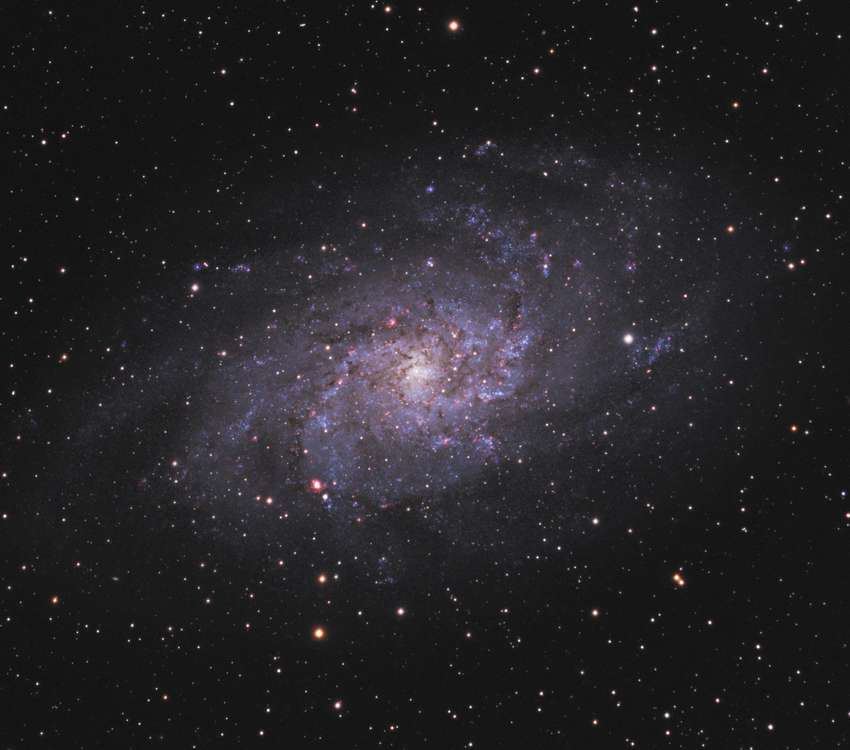
Credit: Hewholooks
Astronomy & Cosmology -
Galaxies


In term of diameter, the Andromeda Galaxy is the largest in our local group, though not, perhaps, the heaviest. The mass of Andromeda, including dark matter, is around 700 billion to 1.2 trillion Solar masses, while the Milky Way appears to contain between 930 billion and 1.9 trillion Solar masses. The averaged distance estimate is about 780 kpc (2.54 million light years) which results in a diameter estimate of about 141,000 light years. Recent studies have shown that there are stars in the disk that extend out much further, giving a revised estimate of the diameter of 220,000 light years. There is evidence that both Andromeda and the Milky Way have stars even further out in their halos, each reaching almost a third of the way across the distance separating them, though the actual star density at that distance is extremely low. These extended halos are probably a function of all disk galaxies. The central region of Andromeda contains a supermassive black hole of between 30 and 50 million Solar masses. Andromeda has fourteen known satellite galaxies, the best known of which are Messier 110 and Messier 32. This amusing picture compares the perceived size of Andromeda to that of the moon.
M101, the Pinwheel galaxy, is a face-on type SAB(rs)cd (intermediate Barred Spiral, between types "c" and "d", with a weak ring structure) galaxy. It is about 7.18 Mpc or 23.4 million light years away. It is a huge spiral some 170,000 light-years across, containing perhaps a trillion stars, so much larger than our Milky Way. There is more information in the section on the Hubble Space Telescope.
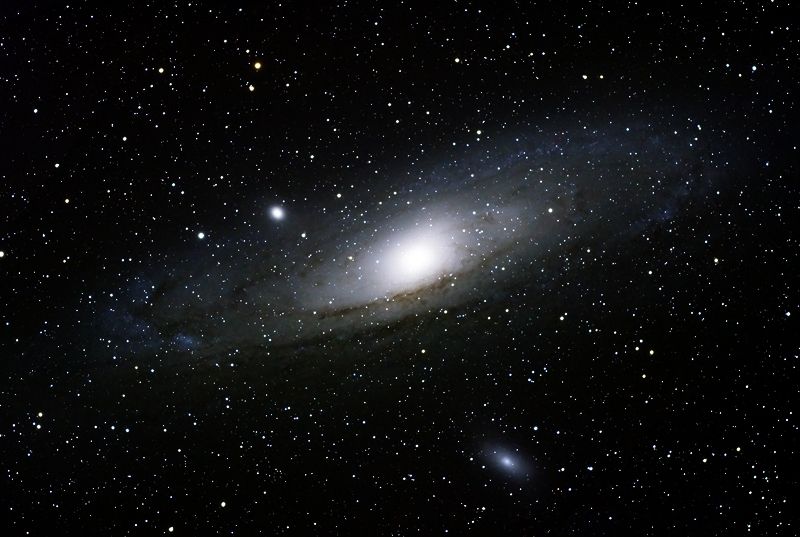
Credit: Boris Stromar
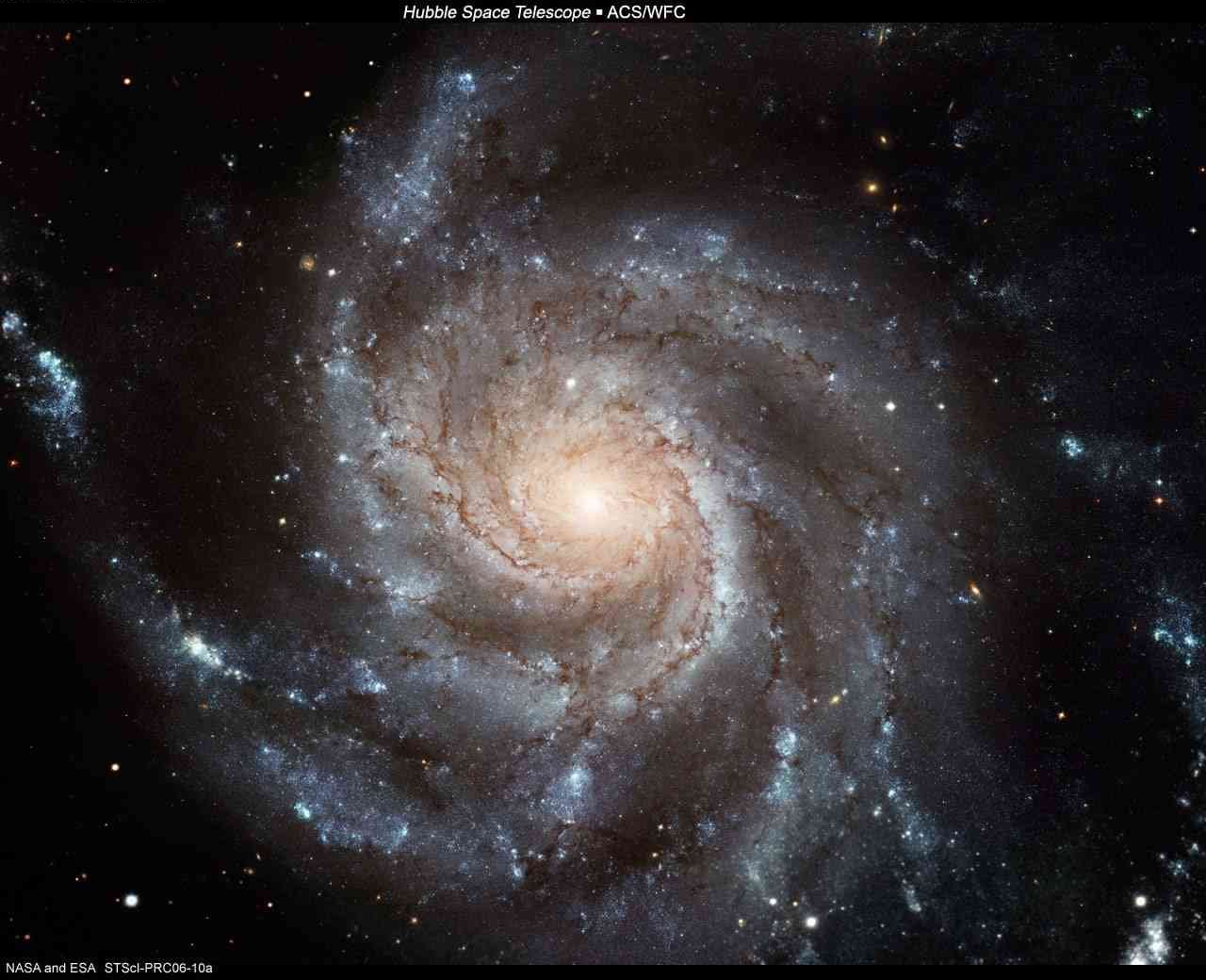
Credit: Hubble
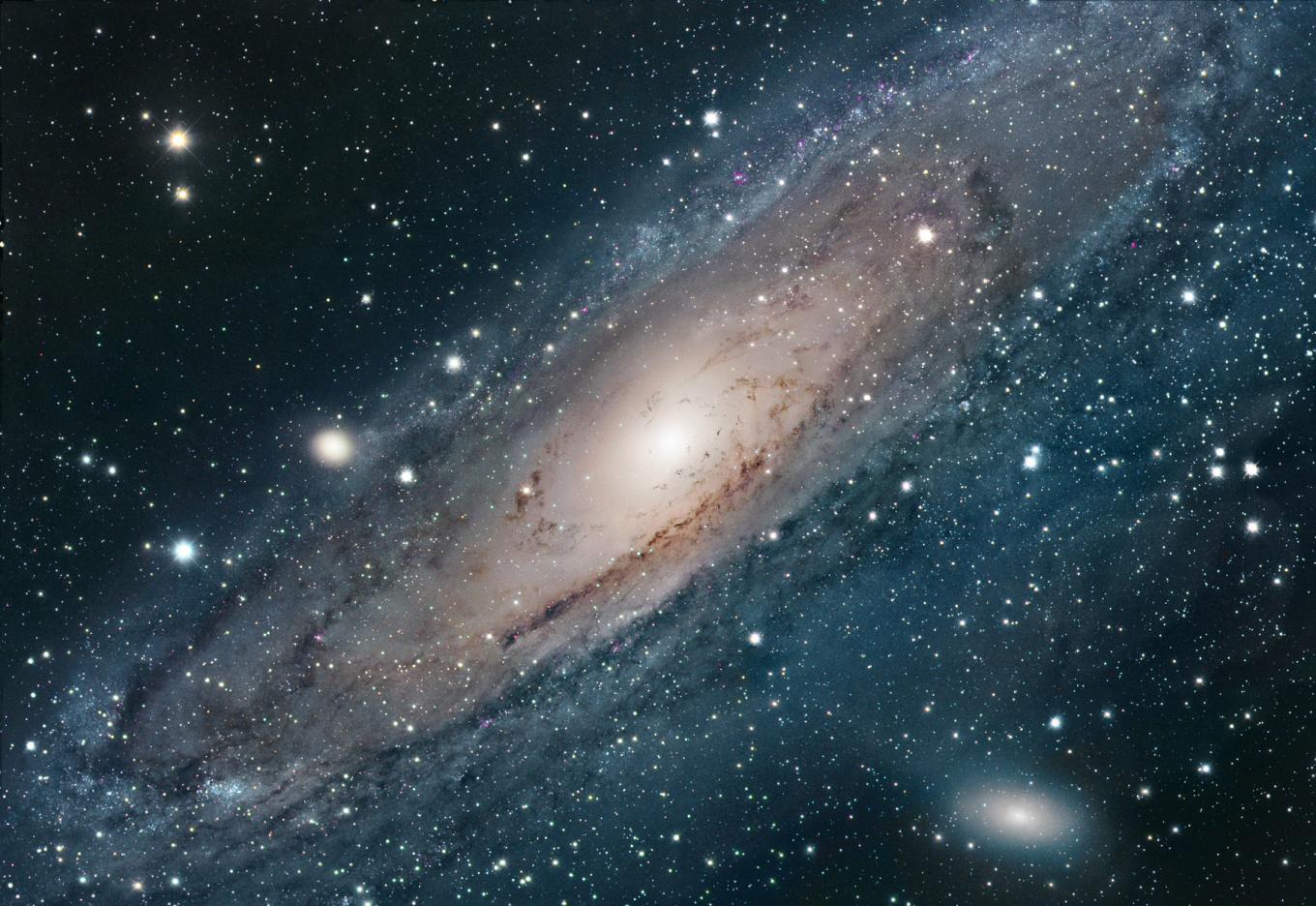
Credit: NASA
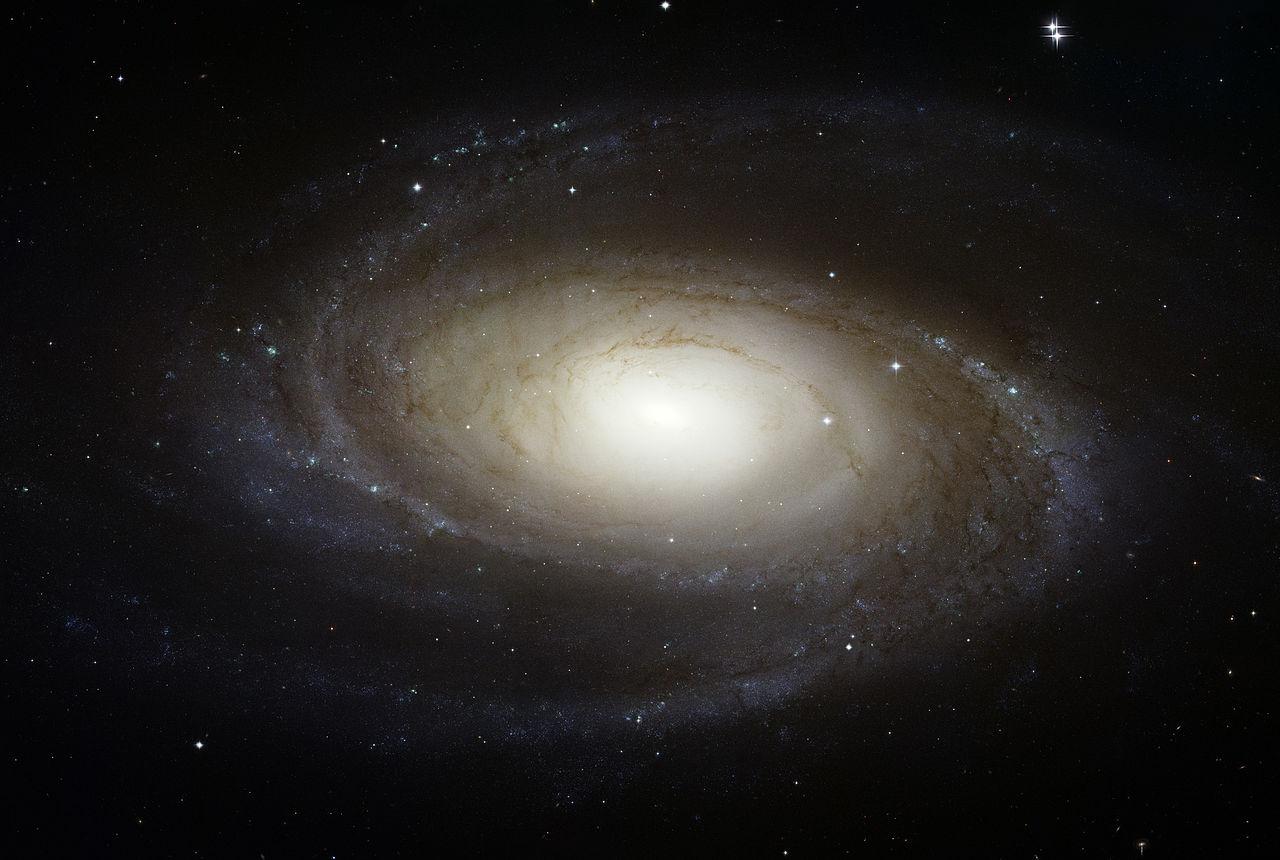
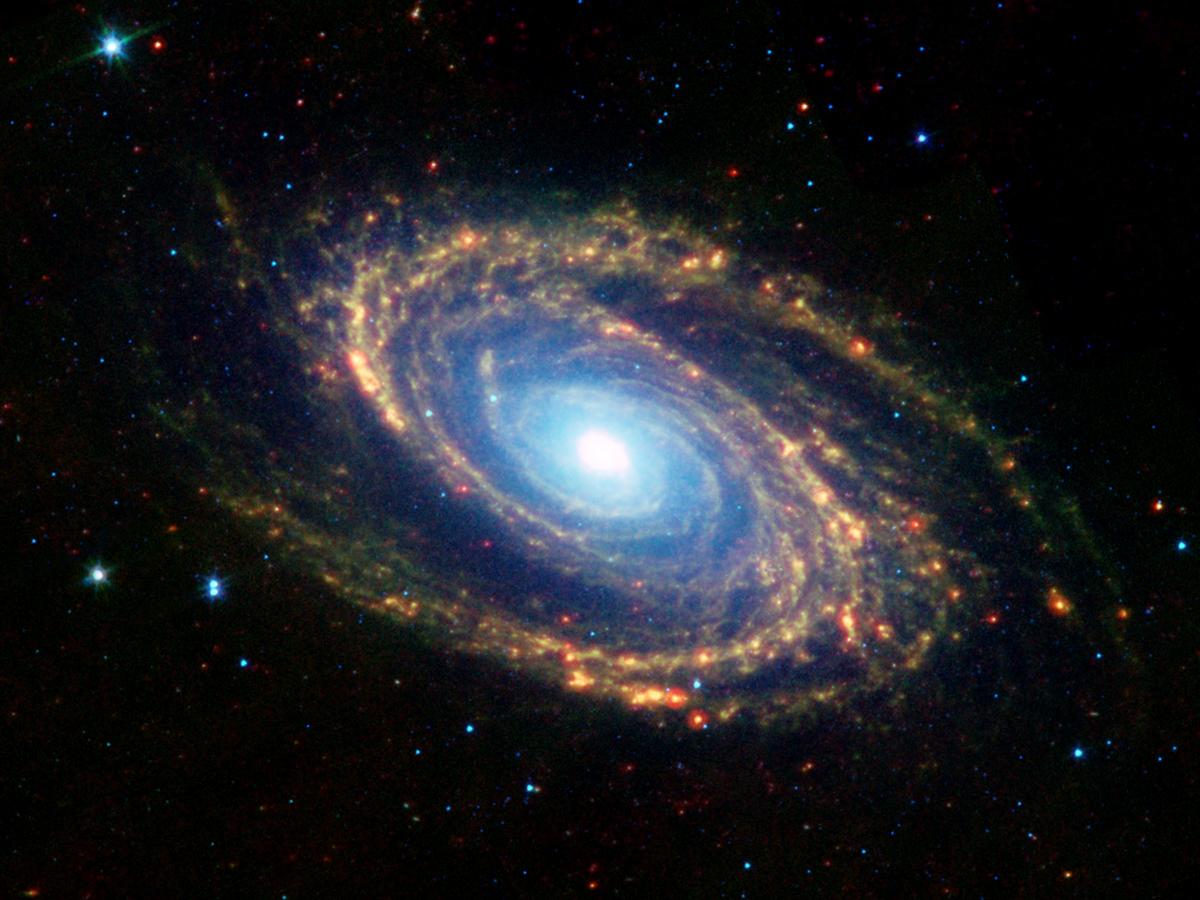
Messier 81, or Bode's Galaxy, is a large type SAab spiral galaxy that is in the M81 group of galaxies about 3.6 Mpc (11.8 million light-years) away. Being relatively close by, it has been studied extensively, and is believed to contain a large central black hole of about 70 million solar masses. While a similar size to the Milky Way, at close to 100,000 light-years across, it is believed to be much less massive due in large part to it containing a rather low density of dark matter. Its core is very small for its size, and incredibly dense.
M81 is gravitationally interacting with two nearby galaxies; Messier 82 and NGC 3077. These interactions have caused the inflow of interstellar gas to the centers of both these galaxies leading to a large increase in the rate of star formation. In fact, M82 probably passed through M81 about 2 billion years ago, when it was severely disrupted. Even today, the centers of the two galaxies are only about 150,000 light-years apart, so they are almost touching.
The supernova, named SN 1993J, observed in 1993, is one of the brightest ever seen. Categorization of the supernova proved difficult; it appeared initially to be a type II, but later took on the characteristics of a type 1b. It has been given an intermediate classification of type Iib.
The upper image was taken in visible light by the Hubble Space Telescope. The lower image was taken in infra-red light by the Spitzer Space Telescope.
M81 is gravitationally interacting with two nearby galaxies; Messier 82 and NGC 3077. These interactions have caused the inflow of interstellar gas to the centers of both these galaxies leading to a large increase in the rate of star formation. In fact, M82 probably passed through M81 about 2 billion years ago, when it was severely disrupted. Even today, the centers of the two galaxies are only about 150,000 light-years apart, so they are almost touching.
The supernova, named SN 1993J, observed in 1993, is one of the brightest ever seen. Categorization of the supernova proved difficult; it appeared initially to be a type II, but later took on the characteristics of a type 1b. It has been given an intermediate classification of type Iib.
The upper image was taken in visible light by the Hubble Space Telescope. The lower image was taken in infra-red light by the Spitzer Space Telescope.
M31 - Andromeda
M33 - Triangulum
M101 - The Pinwheel
M81 - Bode's Galaxy
Both Pictures
Credit: NASA
Credit: NASA
