Elliptical Galaxies
The most massive galaxies in the sky are the giant elliptical galaxies. They can also be very small; perhaps only 1% the size of the Milky Way galaxy. Stars in elliptical galaxies tend to have orbits that are randomly oriented within the galaxy; that is, there is no homogenous rotation like disk galaxies. They can be spherical, like galaxy M87, or more elongated like a rugby ball or American football, for example galaxy M32. The stars tend to be much older Population II stars, and there is little to no free gas or dust. All elliptical galaxies examined to date have had central supermassive black holes, and the mass of these black holes is proportional to the mass of the galaxy. Most people in the field accept the theory that elliptical galaxies form as a result of the merging of galaxies. Astronomers believe that about 60% of all galaxies are elliptical. Size for size, they are much dimmer than disc galaxies.
Classification of elliptical galaxies is based on the degree of ellipticity, on a scale from E0, spherical, with zero ellipticity, to E7, the most ellipsoidal.
Stars are so far apart, compared to their diameters, that it is incredibly unlikely for stellar collisions to occur during a merging of galaxies. However, huge gas clouds will tend to collide with other clouds, and this can trigger the galaxies into making thousands of new stars each year compared to the Milky Way that produces about 4 or 5 new stars each year. In the early universe, galaxies had much more by way of molecular gas clouds than galaxies today so the whole process would have snowballed. The merged galaxy would use up the available gas very quickly making vast numbers of stars. After a few billion years, very little molecular gas would be left, so few if any new stars would form. This is what we see today in elliptical galaxies. The stars tend to be old, and the whole galaxy looks reddish compared to the much brighter, bluer, disk galaxies in which substantial star formation continues.
Classification of elliptical galaxies is based on the degree of ellipticity, on a scale from E0, spherical, with zero ellipticity, to E7, the most ellipsoidal.
Stars are so far apart, compared to their diameters, that it is incredibly unlikely for stellar collisions to occur during a merging of galaxies. However, huge gas clouds will tend to collide with other clouds, and this can trigger the galaxies into making thousands of new stars each year compared to the Milky Way that produces about 4 or 5 new stars each year. In the early universe, galaxies had much more by way of molecular gas clouds than galaxies today so the whole process would have snowballed. The merged galaxy would use up the available gas very quickly making vast numbers of stars. After a few billion years, very little molecular gas would be left, so few if any new stars would form. This is what we see today in elliptical galaxies. The stars tend to be old, and the whole galaxy looks reddish compared to the much brighter, bluer, disk galaxies in which substantial star formation continues.
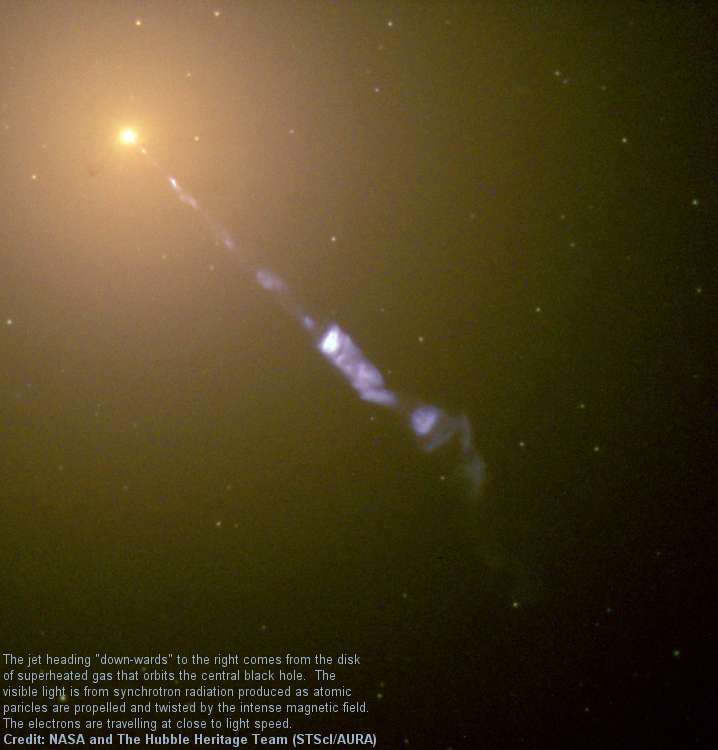
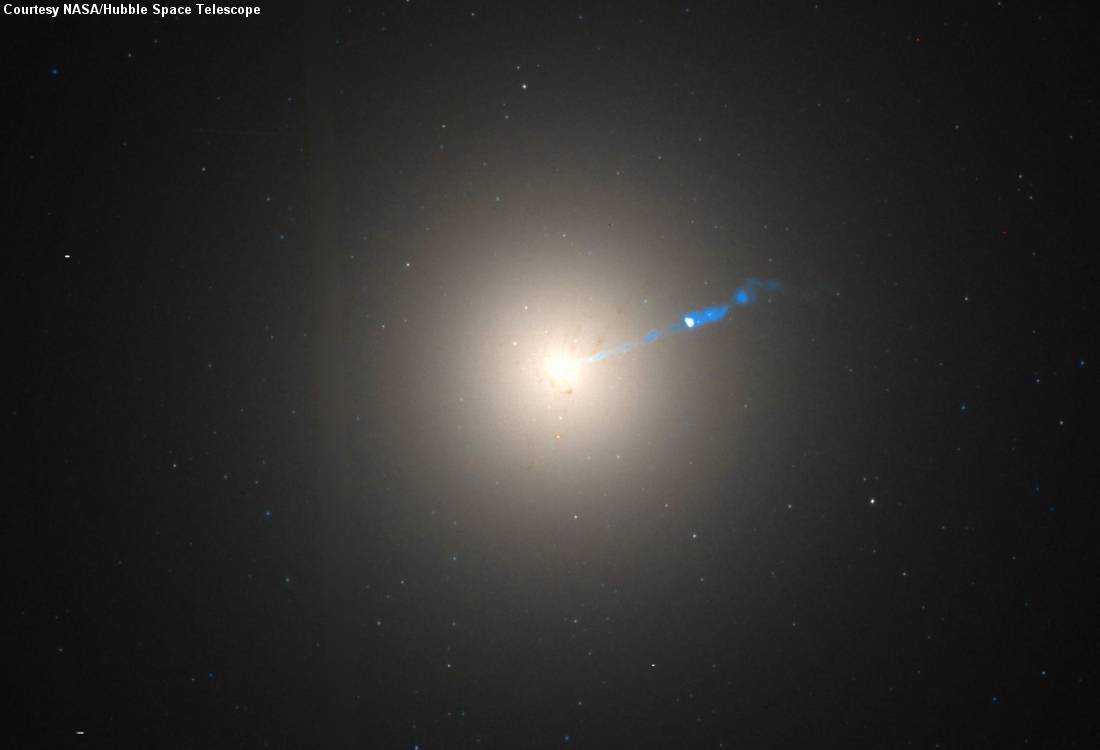
An almost spherical supergiant elliptical, type E0 galaxy, with a very active nucleus that is emitting a huge jet of atomic particles. Situated near to the center of the Virgo Cluster, about 17 Mpc (55 million light years) away, it is about 300 kpc (nearly one million light-years) across which is nearly ten times the diameter of the Milky Way. It weighs in at approximately 200 times the mass of the Milky Way. Its off-center supermassive black hole is over six billion km across, more than the diameter of the orbit of Pluto, and weighs around three to five billion solar masses. The Milky Way has a rather small central black hole that is about 44 million km across, and weighs "only" about four million solar masses. M87 is a real giant among galaxies!
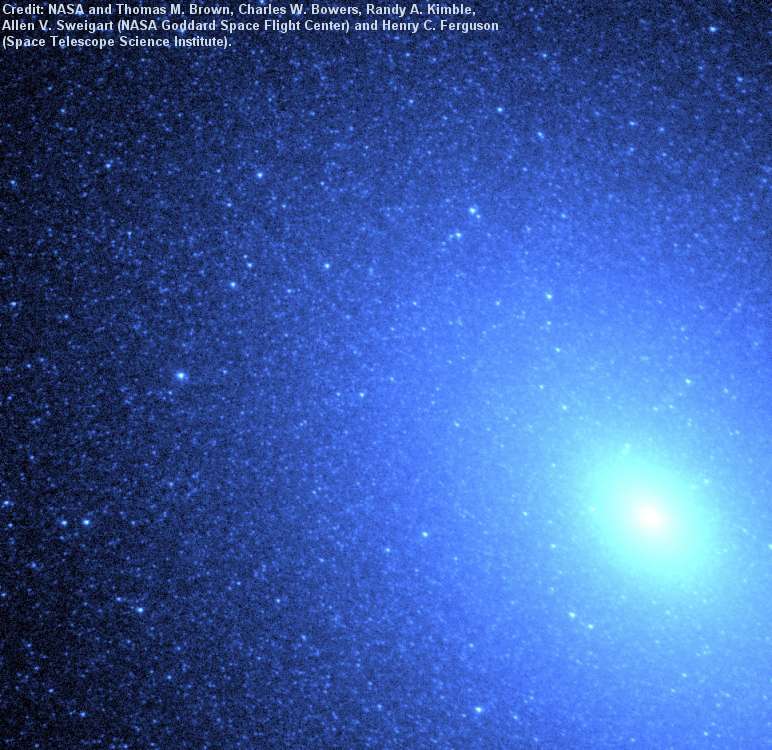
At the opposite end of the scale, M32 is a dwarf elliptical, type E2 galaxy, 763 kpc or 2.49 million light years away, that is a satellite of the nearby Andromeda galaxy, M31. It is only about 2 kpc or close to 6,500 light-years across at its widest point, and weighs about 3.6 billion solar masses. Its central supermassive black hole weighs in at somewhere between 1.5 and 5 million solar masses, which means it could be larger than the one in our much larger Milky Way. It was probably a spiral galaxy that has been disrupted by Andromeda, and what remains was originally just the central bulge that is more difficult to disrupt than the spiral arms.
Astronomy & Cosmology -
Galaxies


M60
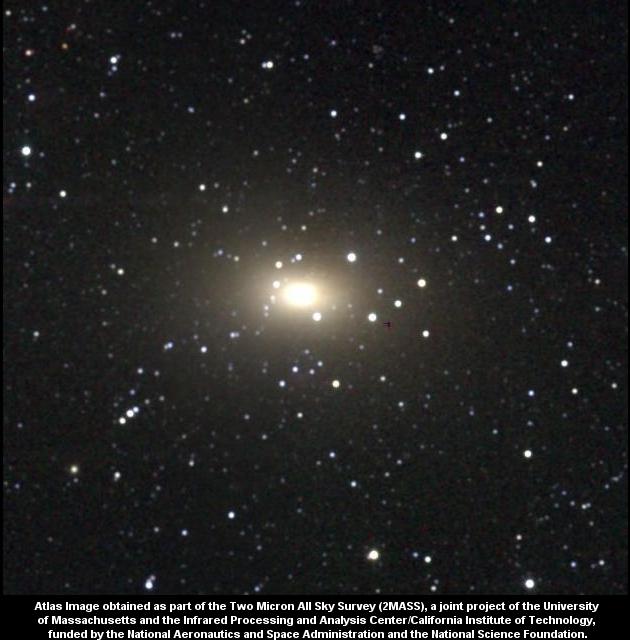
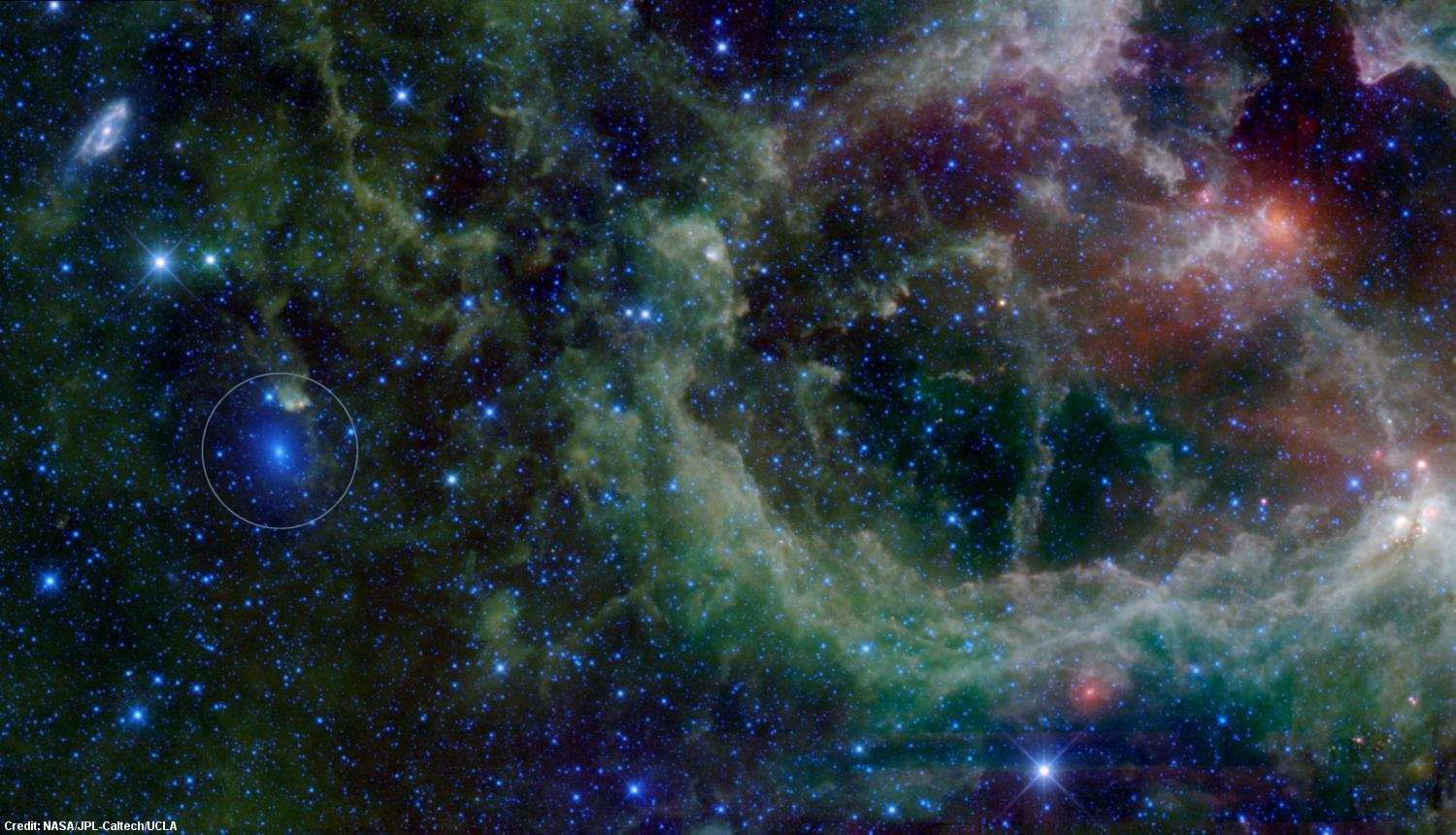
Maffei 1 is the closest known giant elliptical galaxy to our the Milky Way Galaxy, being only about 2.85 Mpc away according to the latest estimates. That is about 3.67 times the distance to our closest giant neighbor the Andromeda spiral galaxy, M31. It is estimated to have a diameter of 23 Kpc (75,000 light-years). Unfortunately dust within the Milky Way makes it very difficult to see at optical wavelengths without a large telescope and dark skies. The left hand image was taken in the near infrared. It belongs to a group of galaxies known as IC 342/Maffei Group, which is one of the closest groups to our own Local Group. It is classified as a type E3, so is somewhat flattened. Typical of large ellipticals, it comprises mainly old stars, many over 10 billion years old, with some new star formation occurring in a small nucleus. Only a limited number of globular clusters have been identified so far, due to the dust issues, but the galaxy is expected to host a large number; perhaps more than 1,000. In the right hand image, Maffei 1 is the bluish object half way down towards the left; it is circled in the larger image. The rest of the image shows part of a large star-forming nebula, IC 1805 or the Heart Nebula, which is about 6.000 light-years away within our Milky Way Galaxy.
M87 - Virgo A
M32 - Le Gentil
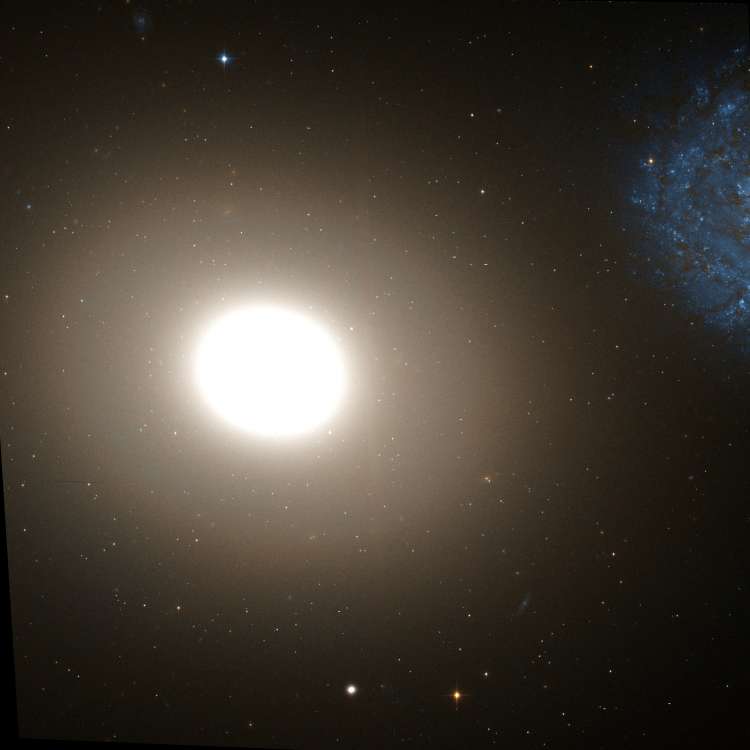
M60 (or NGC 4649) is another supergiant type E2 elliptical galaxy like M87. It is also located in the Virgo Cluster, about 17 Mpc or 55 million light years away. It is about 37 kpc (120,000 light-years) across, and weighs about one trillion solar masses. Its central supermassive black hole weighs in at somewhere around 4. 5 billion solar masses, which is one of the largest ever identified.
Maffei 1