Astronomy & Cosmology
-
Large Scale Structure of the Universe


One Gigaparsec is 3,260 million light-years.
The Shapley Supercluster
Also Known as the Shapley Concentration, it lies approximately 200 Mpc away in the direction of Centaurus, and contains at least 25 clusters of galaxies, and has the mass of approximately 10,000 Milky Way galaxies, concentrated in a volume of space comparable to our own Virgo Supercluster. It is the largest known concentration of matter in the nearby Universe. To produce the observed motion of the Local Group, the mass needed at the Shapley distance is more than 1017 solar masses. The highest estimate for the mass of the Shapley that I have found is 5 x 10¹⁶ solar masses. This would provide less than 50% of the gravitational force necessary. The map to the left shows the location of the Shapley Concentration with respect to the Milky Way galaxy. The direction of the motion of the Local Group is toward the "zone of Avoidance", a large volume of dust within the Milky Way that obscures our vision. Thus, optical astronomy is of little use, and detection of galaxies and clusters relies on X-ray astronomy. As this technique improves, we should find more about what lies beyond Shapley, and explain these anomalies.
While Shapley first identified the region as being abnormally rich in galaxies back in the 1930s, it was not formally recognized as a supercluster until the 1980s, and named the Shapley Supercluster in 1989.
Abell 3558, also known as Shapley 8, is the largest cluster in the Shapley Concentration, and one of the richest clusters known. It is so large, that it seems itself to comprise a number of distinct groups of galaxies. There are two other particularly large clusters; Abell 3559 and Abell 3660. Many astronomers believe that we have yet to see the full scale of the Shapley, and it may turn out to be much larger than it seems.
The Perseus-Pisces Supercluster
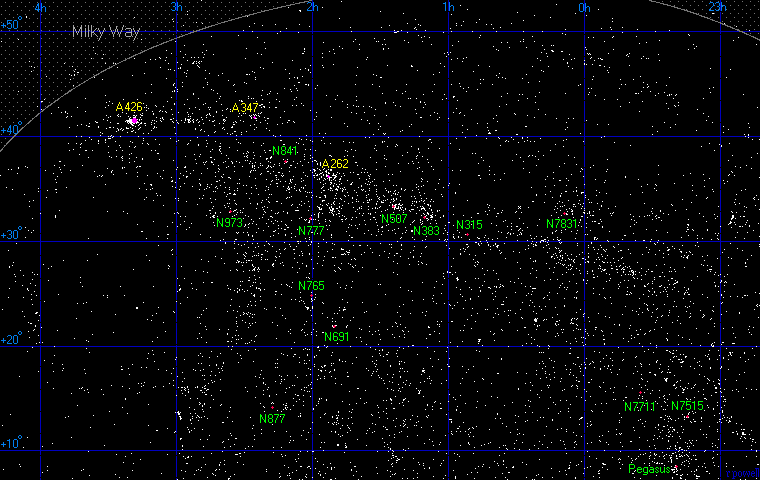
The Perseus-Pisces is a very large supercluster; nearly 100 Mpc long and about 12 Mpc wide, although a large part is obscured by the Zone of Avoidance. It is located about 77 Mpc away. It also borders the large Taurus void which is over 30 Mpc across. Perseus-Pisces is part of the Perseus-Pegasus Filament; see the next section on Filaments & Walls. The main clusters of the Perseus-Pisces Supercluster are Abell 262, Abell 347 and Abell 426, shown in yellow in the image on the right, with A426 (also known as the Perseus Cluster) being by far the richest cluster comprising thousands of individual galaxies. It also includes several other important clusters including the Pisces cluster and the Pegasus cluster.

Superclusters
Superclusters of galaxies involve scales up to gigaparsecs. As discussed in the previous section, our Galaxy, the Milky Way, is in the Local Group of galaxies. In turn, this group is a part of the Virgo, Supercluster which is itself contained within the Laniakea Supercluster. Superclusters are large groups of smaller galaxy groups and clusters, as well as isolated galaxies. They are very large structures spanning between 20 and 100 Mpc or more in their long dimension. They were once thought to be the largest structures in the Universe, but are now seen as components of truly vast walls and filaments. Astronomers believe that there are some 10 million superclusters in the observable Universe. Now for some information on a few of the larger Superclusters that have been identified.
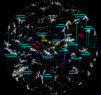
Some of the known super-clusters out to about a 500 million light-year radius from Laniakea; our Local Supercluster shown in yellow.
Astronomers have known since the 1980s that the Milky Way, and the Local Group, is moving towards Centaurus at a speed of between 240 and 480 km/sec (150 and 300 miles/sec) relative to the Cosmic Microwave Background. They called this anomaly the Great Attractor. The direction in which it lies is close to the zone of avoidance in the Milky Way, so it is obscured by dust. Initially, it became associated with the Norma Cluster, and was believed to be a concentration of mass, equivalent to tens of thousands of our Milky Way galaxy, approximately 75 Mpc away. On the scale of the Universe, this is close by. It was thought to affect the motions of galaxies, clusters, and super clusters over a range of many hundreds of millions of light-years. In fact, recent observations show that the Great Attractor region has only about 10% of the mass it was thought to have, and that most of the anomalous motion of the Local Group is due to the Shapley Supercluster that lies behind it. In addition, it is possible that there is an even larger concentration of mass beyond the Shapley Concentration that has not been discovered. Of course, as gravity falls off as the square of distance from us, if a mass were twice as far away as the Shapley Supercluster it would have to be four times the mass to exert the same gravitational attraction.
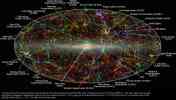
The Great Attractor
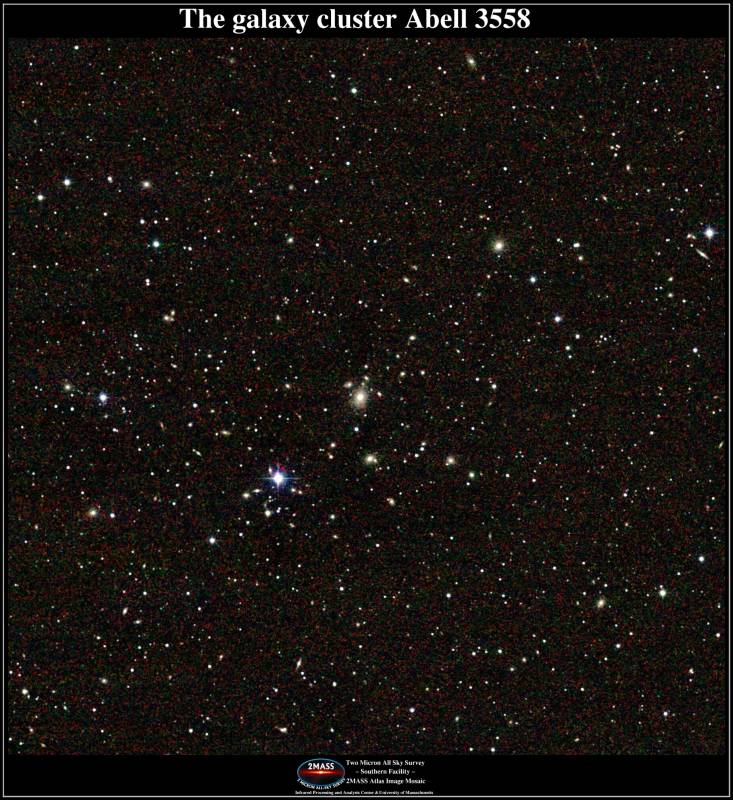
Abell 3558
Virgo Supercluster
The Virgo Supercluster comprises more than 100 groups and clusters of galaxies, of which the Canes Venatici and Virgo Clusters are the largest. About 65% of the component galaxies are in a flattened ellipsoidal disk about 33 Mpc long by 4 or 5 Mpc wide, and 1 Mpc thick, while the remainder are in a roughly spherical halo around the disk. Our Local Group, and hence the Milky Way galaxy, is situated on the outer edge of the supercluster. In all, the supercluster is not especially rich. It does not have a high density core of luminous galaxies, and is not particularly large.
Laniakea Supercluster
The Laniakea Supercluster includes a number of smaller superclusters including the Virgo Supercluster, and by implication the Milky Way and other members of the Local Cluster, the Hydra-Centaurus Supercluster, the Pavo-Indus Supercluster, the Great Attractor, and the Southern Supercluster. Altogether about 100,000 glaxies. Laniakea measures aout 160 Megaparsecs across, approximately 520 million light-years.
The Lynx Arc Supercluster
The Lynx Arc Supercluster is the furthest from us found to date, and is about 3.7 Gpc away. Thus we are seeing it as it was when the Universe was only about 2 billion years old, while it is thought to be around 13.7 billion years old now. Here is an artists impression of the Lynx Arc. It is behind the Lynx Cluster of galaxies, which is around 1.7 Gpc away, though not in any way connected to it as it is much further away. They are both named after the constellation, the Lynx, in which they are seen. You can see the Lynx Arc in this picture (right; click to enlarge) of the Lynx Cluster as a smeared red streak that I have arrowed. In fact we see it gravitationally lensed by an intermediate cluster of galaxies which is why it appears as a streak.
The Lynx Arc contains around one million extremely hot, young, blue stars, and is about one million times brighter than the Orion Nebula. The light we see is predominantly ultraviolet light from these hot stars that has been red-shifted after travelling 12 billion light-years to reach us. This level of intensity of ultra-violet could come only from stars that are very large and hot, with surface temperatures around 80,000º K. This is about twice the temperature of the hottest stars that form today, and is due to the star comprising hydrogen and helium with the density of heavier elements being only about 5% the value for the Sun. Of course this means that with masses several hundred times that of the Sun, they burn much hotter and last for a much shorter life span; possibly one or two million years compared to a star like the Sun that has a lifespan of around 10 billion years.


The Horologium-Reticulum Supercluster
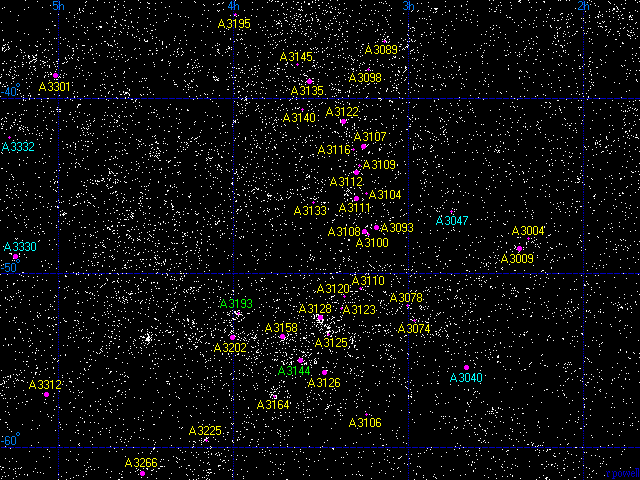
The Horologium-Reticulum Supercluster is a truly massive structure at about 170 Mpc across. At its closest, it is about 215 Mpc away, and at its furthest reach, about 370 Mpc away. The components are shown in yellow in the diagram to the right. Not only is the supercluster physically very large, with approximately 5,000 groups and clusters of galaxies, but it contains an abundance of very rich clusters, including two with Abell richness of "3", the Shapley 20 and Abell 3301clusters, and no less than eight with richness "2". In total, it contains around 350,000 galaxies.
The Lynx Arc Supercluster