So what is a galaxy? Galaxies are large agglomerations of stars, clusters of stars, nebulae, and interstellar gas and dust. They may contain between millions and trillions of stars, and weigh between millions and trillions times the weight of our Sun. Diameters, or at least the largest dimension, vary from a few thousand to several hundreds of thousands of light years. Close to the Milky Way, the Leo I and II dwarf galaxies contain about 1 million stars, while the tiny Draco System has just a few hundred thousand stars. On the other hand, the Andromeda galaxy, our closest large neighbor, contains up to about one trillion stars. The Milky Way is relatively large for a spiral galaxy at about 100,000 light years across. It contains at least 250 billion stars, and possibly twice that number. This is rather less than Andromeda, but the Milky Way and Andromeda probably weigh about the same as it appears that the Milky Way contains more dark matter.
Virtually all galaxies that have been examined in detail, including our own Milky Way and Andromeda, show evidence of having supermassive black holes at their center. Many, like ours, are quiescent, or relatively so. Some, like Messier 87, are extremely active. Although very large, galaxies are usually quite far apart, perhaps millions of light years. But, taking the Milky Way and Andromeda again, which are about 2½ million light years apart, this is only about 25 times the size of the Milky Way. In fact, looking around the Universe, one finds quite a large number of interacting galaxies.
A Nebula is an interstellar cloud of dust and ionized gas which is often where new stars form, and not to be confused with Planetary Nebulae which are the remnants of stars that have thrown off their outer layers toward the end of their lives in the process of becoming white dwarfs or neutron stars. Interstellar gas and dust tends to accumulate in or near the disk of the galaxy. Elliptical galaxies tend to have very little interstellar gas and dust as most has been used up in star formation, often during times of extreme star formation after a collision with another galaxy.
Most galaxies are old; near the age of the Universe itself. The oldest star found so far in the Milky Way, known as HE 1523-0901, is a red giant Population II star about 13.2 to 13.5 billion years old, about 7,500 light-years away, weighing about 0.8 solar masses. The thin disk of our galaxy is thought to have formed somewhere between 6.5 and 10 billion years ago, so some time after the central bulge formed and started star formation there.
Globular star clusters, that orbit in the halos of galaxies, vary in size from perhaps a hundred thousand stars up to several million; almost like a small galaxy embedded in its parent. Some of these very large globular clusters may be the remnants of the nuclei of galaxies absorbed by the larger parent. The Milky Way contains several hundred globular clusters above and below its disc. The stars in these clusters tend to be older, mainly Population II stars.
Virtually all galaxies that have been examined in detail, including our own Milky Way and Andromeda, show evidence of having supermassive black holes at their center. Many, like ours, are quiescent, or relatively so. Some, like Messier 87, are extremely active. Although very large, galaxies are usually quite far apart, perhaps millions of light years. But, taking the Milky Way and Andromeda again, which are about 2½ million light years apart, this is only about 25 times the size of the Milky Way. In fact, looking around the Universe, one finds quite a large number of interacting galaxies.
A Nebula is an interstellar cloud of dust and ionized gas which is often where new stars form, and not to be confused with Planetary Nebulae which are the remnants of stars that have thrown off their outer layers toward the end of their lives in the process of becoming white dwarfs or neutron stars. Interstellar gas and dust tends to accumulate in or near the disk of the galaxy. Elliptical galaxies tend to have very little interstellar gas and dust as most has been used up in star formation, often during times of extreme star formation after a collision with another galaxy.
Most galaxies are old; near the age of the Universe itself. The oldest star found so far in the Milky Way, known as HE 1523-0901, is a red giant Population II star about 13.2 to 13.5 billion years old, about 7,500 light-years away, weighing about 0.8 solar masses. The thin disk of our galaxy is thought to have formed somewhere between 6.5 and 10 billion years ago, so some time after the central bulge formed and started star formation there.
Globular star clusters, that orbit in the halos of galaxies, vary in size from perhaps a hundred thousand stars up to several million; almost like a small galaxy embedded in its parent. Some of these very large globular clusters may be the remnants of the nuclei of galaxies absorbed by the larger parent. The Milky Way contains several hundred globular clusters above and below its disc. The stars in these clusters tend to be older, mainly Population II stars.
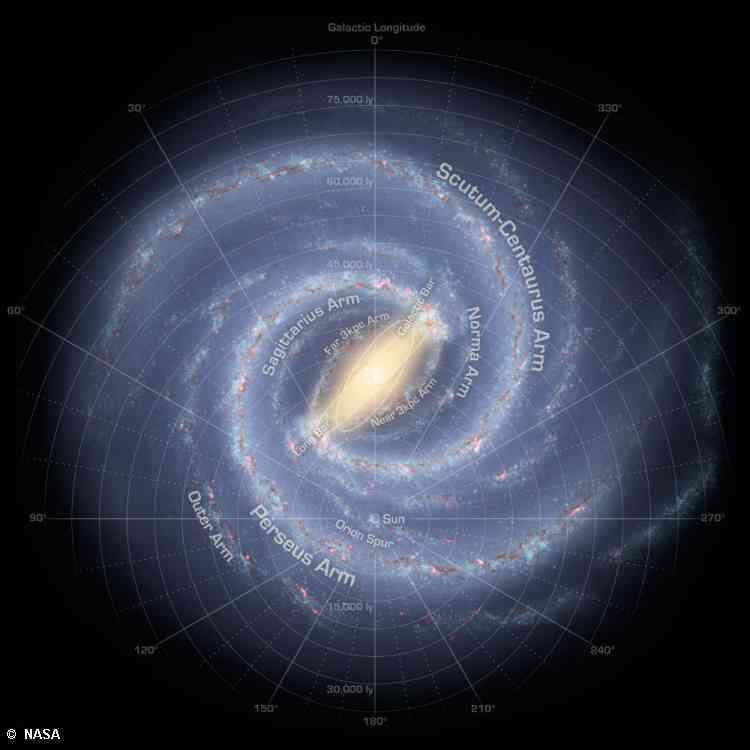
The Milky Way
An artist's impression of the Milky Way galaxy showing the barred spiral structure astronomers believe it has. The grid structure is shown centered on the Sun, which is thought to lie on the Gould Belt on the inner edge of the Orion Spur.
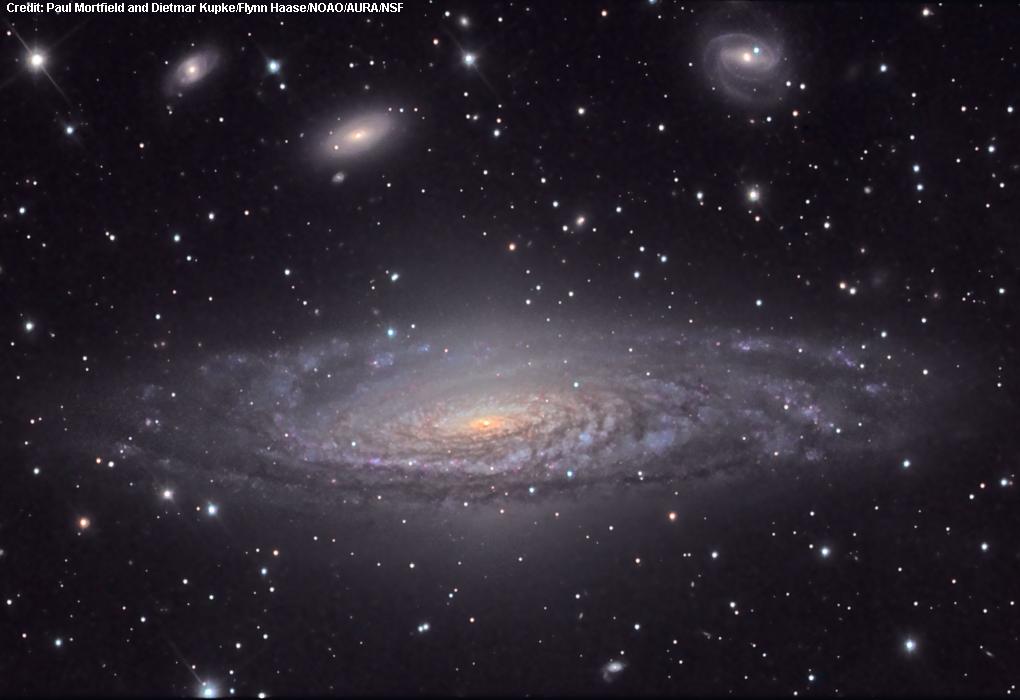
NGC 7331 in Pegasus
A photograph of NGC 7331, a spiral galaxy similar in size and structure to the Milky Way. It is about 12 Mpc (nearly 40 million light-years) away.
Introduction
Astronomy & Cosmology -
Galaxies

